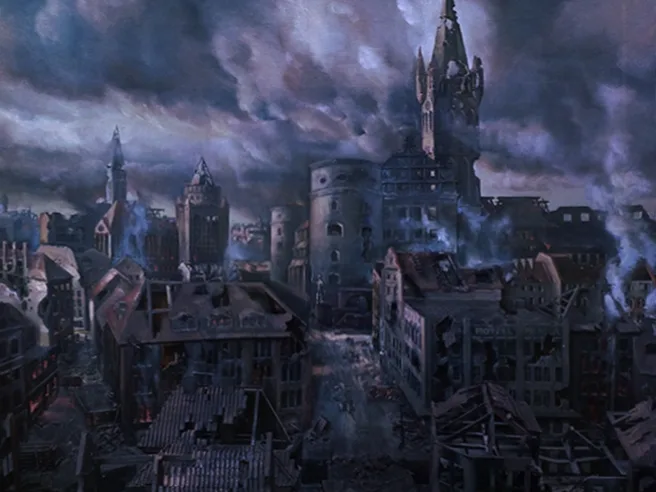


In April 1945 the grounds of the Königsberg Zoo formed part of the Germans' inner defensive line. The overwhelming majority of the animals had already been evacuated in the autumn of 1944 and housed on various estates across East Prussia. In the zoo itself, or rather in its northern part facing Hermannallee (now Tchaikovsky Street, in the area of the tennis court and the children's playground), a battery of medium-calibre anti-aircraft guns (about 4 of them) was concentrated, along with several anti-personnel and anti-tank guns and machine-gun nests, all linked to one another by communication trenches. The guns faced north-west, towards Tchaikovsky Street, since that was precisely the direction from which the Soviet offensive was developing.
Mortar nests, riflemen and Volkssturm fighters were also dispersed throughout the zoo.
In addition, there was a tall wooden observation tower on the zoo grounds. The platform at the top was rectangular, with a balustrade, which made it possible to watch the approaching Soviet troops.
It is now rather difficult to establish exactly which German units defended the zoo grounds, since the enemy only fell back here after Soviet units had broken through the Germans' main defensive belt. The troops that gathered here came from various units. In all probability, however, the remnants of the badly battered regiments of Major General Erich Hermann Sudau's (1898-1945) 548th Volksgrenadier Division retreated into the zoo area from the north-western parts of the city – in particular Lieutenant Colonel Bernard's 1095th Grenadier Regiment and Lieutenant Colonel Wendland's 1094th Grenadier Regiment. Wendland's regiment included, as its 3rd battalion, Kapitänleutnant Dietrich's 121st Naval Rifle Battalion (something like our marines, only of lower quality; such battalions were formed from Kriegsmarine shore-service personnel only in the last six months of the war).
With its broken terrain, the zoo neatly covered the approaches to the high-banked stream Hufenfreigraben (more precisely a ditch or ravine; today Parkovy Stream; in Soviet military documents it quite often appeared as the "canal south of block No. 277").
It was indeed a natural obstacle on the way into the very centre of Königsberg, and the Soviet troops still had to overcome it.
The Königsberg Zoo lay in the attack sector of the 126th Rifle Division of 45-year-old Colonel Fyodor Andreyevich Safronov, part of the 54th Rifle Corps under Lieutenant General Aleksandr Sergeyevich Ksenofontov. In the afternoon of 8 April, the German positions in the zoo area were struck directly by the 366th Rifle Regiment of 35-year-old Lev Andreyevich Bazarnov.
In the afternoon of 8 April (at about 16:00, according to the regiment's and the division's combat reports), the battalions of the 366th Rifle Regiment approached the zoo area from the blocks around Hagemannstrasse (Karl Marx Street) along Hermannallee (Tchaikovsky Street). In many respects this day became the turning point of the assault on the city, as the advancing armies, striking concentrically, split the enemy's defences and threw him back into the central part of the city.
The 1st Rifle Battalion of 24-year-old Major Nikolay Mamontov approached the zoo from the north-west. The scouts sent ahead quickly assessed the situation.
The regimental commander's task was to drive the Germans out of the part of the zoo adjoining the stream and to force the stream, building a crossing over it for the remaining units.
A battle soon broke out, in which the mortar platoon of 21-year-old Junior Lieutenant Grigory Gorkov, sappers and gunners of the 358th Artillery Regiment of the 126th Division also took part. The artillery regiment had been distributed battery by battery among the assault rifle units of the division's regiments. From the north, moving south-east at the junction with the 366th Regiment, the 1st Battalion of Lieutenant Colonel Yefim Salenko's 690th Rifle Regiment was advancing, and its men also opened fire on the Germans in the zoo. The enemy responded with a hail of artillery and mortar fire. The advance stalled, yet some of the men broke through onto the zoo grounds themselves. And so the fighting moved into the zoo itself. One can imagine what was happening to the last remaining terrified animals.
Further progress was possible only thanks to the courage and initiative of individual soldiers and commanders, riflemen and gunners alike.
The rifle platoon of Lieutenant Vasily Lapshin of the 2nd Rifle Company slipped unnoticed around the flank of the defending Germans along Tiergartenstrasse (now Zoologicheskaya Street). He then split his platoon into two parts and attacked from the rear and the flanks the German units that were defending the bridge over the stream. This came as a complete surprise to the Germans. Lapshin's men shot some of the Germans in the trench; others raised their hands.
It was evidently the breakthrough of Lapshin's unit that allowed the command to report the capture of the zoo. According to the documents, the battle for the zoo began at 16:15 and was over half an hour later. In reality, however, the fighting lasted longer.
While Vasily Lapshin's men were finishing off the Germans in the trenches in the southern part of the zoo, a battle was raging on the northern edge of the park. But the Germans were by now forced to turn their attention to their rear, where Lieutenant Lapshin's group had broken through. The gunners of the 1st and 2nd battalions of the 358th Artillery Regiment, positioned within the combat formations of the 366th Rifle Regiment's infantry, opened direct fire on the German firing points – artillery and machine-gun positions alike. A duel ensued. Thus the 45-mm gun of Andrey Bondar from Lieutenant Vladimir Borisov's gun platoon destroyed 2 German guns and 4 machine-gun nests and demolished a small house in which the enemy had set up a firing point. The gun of 21-year-old Senior Sergeant Pavel Voronkov also distinguished itself, destroying a machine gun in a stone building and silencing an anti-tank gun. The artillery regiment's signallers played a major role in coordinating the gunners' actions. The 1st Battalion's 19-year-old telephone operator Sasha Levchenko repaired 20 breaks in the communication line under the heaviest fire.
Two commanders of 76-mm guns – Junior Sergeant Vasily Khilchuk and Sergeant Major Aleksandr Cheremukhin – decided with their guns the outcome of the fight for a heavily fortified house in the southern part of the zoo. With the fire of his gun Vasily Khilchuk destroyed a mortar battery and four machine guns and blew up an enemy ammunition depot. By the end of the day, resistance inside the zoo came from only one large three-storey house, half destroyed by shells. The gunners rolled their 76-mm guns up to it and destroyed the machine-gun positions with a few shots. The surviving German soldiers moved into the cellar of the house and kept on resisting. Sergeant Major Cheremukhin crawled up to a cellar window and pelted the German machine gunners with anti-tank grenades.
On the evening of 8 April, the infantry of Major Nikolay Mamontov's 1st Battalion pushed the Germans back to the southern and south-eastern edges of the zoo.
Late at night the sapper platoon of the 366th Regiment fought its way through to the high-banked stream Hufenfreigraben and, despite enemy fire, began building a crossing. During its construction Sergeant Yakov Kalyakin and Junior Sergeant Nikolay Trikoza, who was wounded, distinguished themselves.
During the night of 8 to 9 April the entire zoo grounds were cleared of the enemy. About a hundred Wehrmacht soldiers were taken prisoner; the others were either killed or withdrew deeper into the city. Other units began moving into the zoo and its surroundings. Thus ISU-152 "Zveroboy" self-propelled guns of Guards Lieutenant Colonel Vasily Konontsev's 345th Guards Heavy Self-Propelled Artillery Regiment (hereafter the Gds. HSPAR) arrived as reinforcements.
The Germans, however, did not want to accept the loss of an advantageous position, and as early as the morning of 9 April they managed to organise a counter-attack on the positions of the 126th Division. The counter-attack involved 4 armoured vehicles accompanied by infantry numbering up to two companies. A major role in repelling the German thrust was played by the mortarmen, the gunners and the self-propelled gun crews of the 345th Gds. HSPAR. The commander of a mortar platoon of the 366th Regiment, 22-year-old Junior Lieutenant Grigory Gorkov, swiftly organised the defence and, with the forces of his platoon (three mortars), opened a hail of mortar fire on the Germans. According to the documents, in 10 minutes of fighting his platoon fired some 500 rounds at the enemy (i.e. each mortar was pouring out 16 rounds a minute). The Germans tried to suppress the mortarmen with return fire. Fragments of a round that exploded nearby gravely wounded Junior Lieutenant Gorkov, but he did not leave his position and went on commanding his platoon until he was killed by the explosion of another round. Another mortar platoon (three mortars), that of 22-year-old Lieutenant Boris Uryadnikov, fired 450 rounds at the enemy in the same 10 minutes.
At the same time our machine gunners were also firing at the enemy. The commander of a rifle platoon, Junior Lieutenant Sergey Krylov (also 22 years old), personally fired a machine gun at the advancing Germans. Gravely wounded, he did not leave the battlefield but went on directing his men. Men of the 5th Company of the 2nd Rifle Battalion of the 690th Rifle Regiment also poured heavy fire on the Germans.
A significant role in repelling the German counter-attack was played by the close coordination of all units, which was ensured by the signallers of Captain Yakov Krutov's 233rd Separate Signal Battalion.
The telephone line constantly suffered from German shelling. Telephone operator Andrey Klimkin, who served as lineman on the communication line between the commander of the 366th Regiment and the headquarters of the 126th Division, repaired 27 breaks in the line in the zoo area. Telephone operator Vasily Sergeyev repaired 21 breaks.
The turning point came when our heavy self-propelled guns joined the battle. The repulse of the counter-attack on the self-propelled gunners' side was led by the regiment's chief of staff, Guards Captain Viktor Lipin. He was with the self-propelled guns in their combat formations and personally directed the battle. With the fire of their heavy 152-mm guns the "Zveroboys" destroyed two self-propelled guns, four armoured personnel carriers, 5 anti-tank guns and 7 machine-gun positions. After the losses they had suffered, the Germans stopped their counter-attacks.
In the first half of 9 April, active fighting around the zoo ceased. The fate of the German units that had defended the zoo was retreat into the central districts of the city and subsequent capitulation. The commander of the 548th Volksgrenadier Division, Major General Erich Sudau, was killed during the night of 8 to 9 April while the German group was attempting to break out of the city in the area of the Luisenkirche (the Puppet Theatre). On 9 April the commander of the 1094th Grenadier Regiment, Lieutenant Colonel Wendland, together with his staff, was surrounded by a group of scouts led by Captain Vasily Rykov, assistant chief of reconnaissance of the 263rd Sivash Rifle Division. The regimental commander offered no particular resistance – he understood that resistance was hopeless – and soon surrendered to the Soviet soldiers together with his adjutant.
Only four animals survived the battle in the zoo – a fallow deer, a donkey, a badger and a hippopotamus, whose condition was very poor. During the fighting it had been hit by seven bullets and shell fragments.
Soviet soldiers found the hippopotamus in a small ditch on the edge of the zoo. Only five days after the end of the fighting the hippo began to be treated by 27-year-old Sergeant Vladimir Polonsky, a machine gunner of the 1291st Rifle Regiment of the 110th Rifle Division of the 50th Army. Taken prisoner near Smolensk back in July 1941, he was liberated only in the summer of 1944 and went on serving in the ranks of the Red Army. Commanding a machine-gun crew, he distinguished himself in the fighting at Heilsberg (where he was seriously wounded) and in Königsberg. A livestock specialist by profession, he was attached to the zoo and nursed the hippopotamus until the summer of 1945, and also looked after the remaining animals, surrounding them with care.
Heroes of the Soviet Union
Rifle platoon commander Lieutenant Vasily Lapshin of the 2nd Rifle Company, who had largely determined the outcome of the battle for the zoo on 8 April, was recommended for the title of Hero of the Soviet Union by regimental commander Bazarnov as early as 13 April; on 14 April the divisional commander endorsed the recommendation, and on 15 April corps commander Ksenofontov endorsed it as well. Whether Vasily Lapshin himself, who by then had already been appointed commander of a rifle company, knew of this we will probably never find out. On 15 April he was killed during the Samland offensive near the Kondehnen estate (it no longer exists; it lay near the railway branch leading to Sodruzhestvo-Soya LLC). The decree posthumously conferring on him the title of Hero of the Soviet Union, with the Order of Lenin and the Gold Star medal, was issued on 19 April 1945. The hero is buried in the settlement of Vzmorye (Svetly urban district).
On 11 April 1945 Vasily Lapshin wrote to his wife Yevdokiya Alekseyevna and his daughter Yevgeniya in Leningrad:
"Hello, my dear wife Dusya and daughter Zhenya. Please forgive me for not writing for so long. I am writing to let you know that I am alive and well. On 10 April we rested. We have taken Königsberg. My unit has become very small – some were killed or wounded. We took many prisoners. They resisted fiercely – they sat in attics and cellars. Our artillery and air force helped us a great deal. The fascists are surrendering in whole droves. Well, that's all for now. We're moving on to finish off the group that has dug in over there."
The commander of the 1st Rifle Battalion, 24-year-old Major Nikolay Mamontov, was also awarded the title of Hero of the Soviet Union for the fighting in Königsberg. With his battalion he was among the first to burst into the town of Fischhausen (Primorsk) a week after the end of the assault on Königsberg (17 April). After the war he graduated from the M.V. Frunze Military Academy and served in the army for many more years. In his later years, retired Colonel Nikolay Mamontov lived in Ukraine, in the town of Zhmerynka near Vinnytsia, and died in 2000.
In all, the 126th Rifle Division lost about a hundred men and officers killed in the fighting in the Königsberg area, and the 366th Rifle Regiment itself some 30 men.
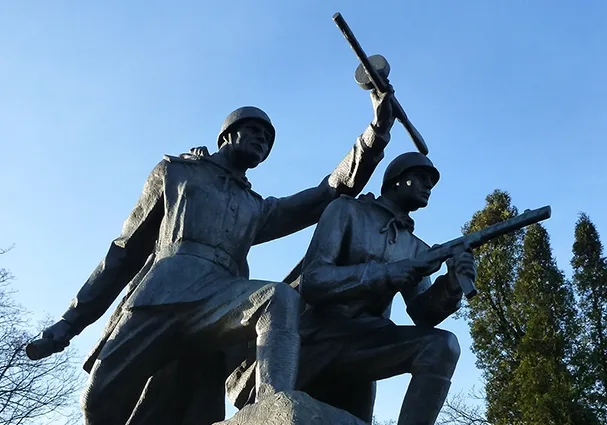
Photo by Mikhail Ogorodnikov.