

1941
By the beginning of the Great Patriotic War the Baltic Fleet was a very considerable force. It comprised 68 submarines, 2 battleships, 2 cruisers, 2 destroyer leaders, 19 destroyers, 2 gunboats, 7 patrol ships, 4 minelayers, 24 minesweepers and 95 motor torpedo boats and patrol boats. With the outbreak of war the fleet grew still further thanks to mobilised civilian vessels, which were used as gunboats, patrol ships and boats, minelayers and minesweepers.
The beginning of the war proved just as catastrophic for the Baltic Fleet as for the Red Army as a whole.
In part the fleet suffered because the army was rapidly retreating, giving up naval bases and reducing the radius and flight time of German bombers. But the sailors themselves fought, to put it mildly, not very well. The most glaring example is the engagement of 6 July 1941 between the destroyers "Silny" and "Serdity" and the German depot ship MRS-11 and minesweeper M-31. In terms of the balance of combat power this was a contest between two boxers (the Soviet destroyers) and two little boys (the German ships). The result, however, was that the German ships received no damage at all, while the Soviet destroyers survived by a miracle after a German shell hit the mines stacked on the stern of one of them.
In August the enemy approached the fleet's main base, Tallinn, which for completely incomprehensible reasons had not been evacuated in good time. The Baltic Fleet's passage to Kronstadt on 27–30 August, through continuous minefields and under constant attacks by German aircraft and motor torpedo boats, became the greatest catastrophe in the entire history of the Russian navy (far worse than Tsushima). The losses were: 2 submarines, 5 destroyers, 1 gunboat, 3 patrol ships, 5 boats and 44 transport and auxiliary vessels. The number of dead has still not been established, but it clearly exceeded 10,000. The Germans lost only 3 aircraft.
In all, in 1941 the Baltic Fleet lost (including mobilised vessels): 25 submarines, 1 battleship (although it "did not quite perish" — more on this below), 1 destroyer leader, 16 destroyers, 2 gunboats, 6 patrol ships, 2 minelayers and 1 netlayer, 48 minesweepers, 1 armoured boat, 24 motor torpedo boats and 31 patrol boats. The enemy's losses in the Baltic were utterly incomparable with ours. Soviet submariners sank 1 enemy submarine and 1 transport of 3,784 GRT, airmen sank 1 small minesweeper, and motor torpedo boats another small minesweeper and 1 patrol ship (a mobilised trawler). The ratio is simply off the scale.
Nevertheless, it was in 1941 that the Baltic Fleet, and through it the Soviet Navy as a whole, accomplished a task of strategic importance — the only time in the entire war — and did so with extraordinary success.
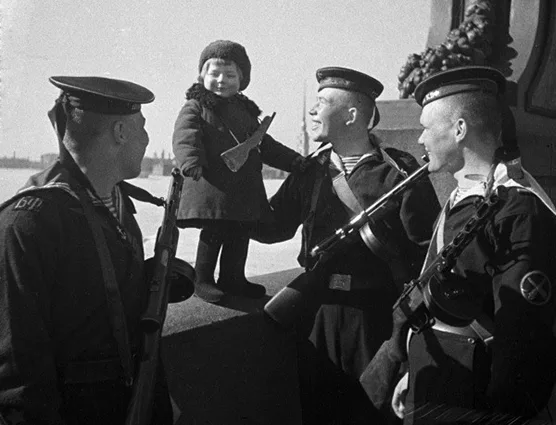
Their artillery — the 305-mm guns of the battleships, the 180-mm guns of the cruisers, the 130-mm guns of the destroyers — became the very "crowbar" against which the Germans had no defence. In essence, it was the large surface ships of the Baltic Fleet, firing on German troops straight from Kronstadt and from the Neva, that prevented the Germans from taking Leningrad in the autumn of 1941, the fall of which could have had entirely unpredictable consequences, up to and including losing the war altogether (this subject deserves a separate article). The Germans, however, tried to destroy the ships from the air. The first series of air strikes on Kronstadt was carried out at the end of September 1941. Formally they proved very successful: the battleship "Marat" and the destroyer leader "Minsk" were sunk. However, the "Minsk" was soon raised and returned to service, while the "Marat" settled on the bottom in Kronstadt harbour and until January 1944 was used as an artillery battery: 9 of its 12 305-mm guns continued successfully to destroy German troops. The second series of strikes was carried out at the end of April 1942, but this time the Germans failed to sink a single Soviet ship.
Working successfully against the shore, the Baltic Fleet, bottled up in Kronstadt and Leningrad, practically lost the ability to fight at sea.
From June 1941 the Germans continuously sowed the Gulf of Finland with thousands of mines, making it completely "impassable". The actions of the surface forces were therefore reduced to clashes between Soviet boats and Finnish and German boats among the skerries of the eastern Gulf of Finland.
1942
In 1942 the Baltic Fleet lost 2 gunboats, 2 patrol ships, 12 motor torpedo boats and 9 patrol boats, and 8 minesweepers. Meanwhile Soviet motor torpedo boats sank 1 German patrol ship, and airmen another patrol ship and a small minesweeper; that is, the ratio of losses remained catastrophic for us.
The Soviet submarine fleet, it is true, was active in the Baltic in 1942. At the cost of 12 submarines it sank at least 20 transports (with a total capacity of 47,527 t) and 2 schooners. Six of these transports belonged to neutral Sweden; that is, the Soviet submariners were in a sense violating the laws of war. However, all the Swedish transports were carrying to Germany, which was at war with us, the most important strategic cargo — iron ore. Their neutrality was therefore highly nominal. In effect, until 1945 Sweden was a non-belligerent ally of Germany.
Although the losses caused by Soviet submarines amounted to an insignificant share of total sea traffic, they were nonetheless very unpleasant for the Germans.
So the Gulf of Finland was sown with mines until it became utterly impassable.
1943
In 1943 the Baltic Fleet lost 5 submarines, none of which broke through into the Baltic and, accordingly, sank anything. In addition, the fleet lost 1 gunboat, 6 minesweepers, 7 motor torpedo boats and 9 patrol boats. In return our motor torpedo boats sank 1 Finnish minelayer. Soviet aviation, it is true, became somewhat more successful. In 1943 it sank 1 patrol ship, 1 floating battery, 3 motor torpedo boats, 3 transports and a lighter with a total capacity of 8,567 GRT. While successfully helping the land forces in defence, the fleet was entirely dependent on them when it came to offensive operations. Here the situation changed radically in 1944.
1944
In January 1944 Soviet troops (again with considerable support from the Baltic Fleet's artillery) completely lifted the siege of Leningrad, and in June they launched an offensive against Finland. In purely military terms this country was Germany's most capable (or rather, its only capable) ally. However, Finland's de facto leader Carl Mannerheim, a former officer of the Russian Imperial Army, very successfully sabotaged, for almost the whole war, all joint offensive operations with the Wehrmacht beyond his country's pre-1940 borders, and after Stalingrad thought only of how to "bail out" with the fewest losses.
After Soviet troops had once again reached the 1940 borders, Finland capitulated to the USSR on 2 September 1944, and from 15 September began full-scale military operations against the German troops remaining on its territory.
Via Finnish bases and fairways the Baltic Fleet once again gained access to the Baltic. As a result, in the last three months of 1944 Soviet submariners, at the cost of one submarine, sank 10 transports (including 1 Swedish) with a total capacity of 31,333 GRT, and 2 trawlers.
For most of 1944 the Baltic Fleet's surface forces fought in the eastern Gulf of Finland, and only at the end of the year did they break out into the Baltic, securing the capture of the Moonsund archipelago after Soviet troops had liberated mainland Estonia. During the year they lost 1 gunboat, 3 armoured boats, 16 motor torpedo boats and 19 patrol boats, and 27 minesweepers. In return Soviet motor torpedo boats sank a torpedo boat and a minesweeper. The ratio of losses was once again appalling, although the torpedo boat T-31, sunk on 20 June by the motor torpedo boats TK-37 and TK-60, became the largest German warship sunk by ships of the Soviet Navy during the entire Great Patriotic War. In addition, on 20 July the submarine chaser MO-103 sank the German submarine U-250, which was soon raised by Soviet divers; two of the newest acoustic homing torpedoes were recovered from it, one of which was handed over to the British (for whom the fight against German submarines was still a very pressing issue).
Thanks to the army's advance westwards, conditions improved sharply for the operations of the Baltic Fleet, which could now reach almost any point in the Baltic.
In 1944 they sank 1 German submarine, 1 torpedo boat, 4 patrol ships, 1 patrol boat and 1 motor torpedo boat, 1 anti-aircraft floating battery, 4 artillery barges, 11 minesweepers, 1 mine transport and 2 fast landing barges. Particular mention must be made of the anti-aircraft floating battery "Niobe" — the former Dutch cruiser "Gelderland" — sunk by Soviet airmen on 16 July in the Finnish port of Kotka.
1945
In the victorious year of 1945 the situation for the Baltic Fleet improved radically as the land forces captured a considerable part of the Baltic coast in Latvia, Lithuania and then Poland. The fleet was able to operate throughout the Baltic, and moreover under conditions of complete Soviet air supremacy.
In 1945 Soviet submariners, at the cost of one submarine, sank with torpedoes and mines 1 submarine, 2 torpedo boats, 1 patrol ship, 8 transports with a total capacity of 58,147 GRT, and 1 schooner. Most of the German tonnage sunk is accounted for by the well-known outstanding patrol of S-13, during which it destroyed the liner "Wilhelm Gustloff" (25,484 GRT) and the troop transport "Steuben" (14,660 GRT). The number of dead on the "Gustloff" exceeded 9,000. More than 7,000 people died when the submarine L-3 sank the transport "Goya".
To this day the sinkings of the "Gustloff" and the "Goya" remain the largest maritime disasters in history in terms of the number of dead.
A very large proportion of them were civilians — refugees from East Prussia. For this reason, in recent years certain historians and journalists in Germany have begun calling the commanders of S-13, Aleksandr Marinesko, and of L-3, Vladimir Konovalov, war criminals. Which is, to put it mildly, strange. Mass atrocities against the population of occupied territories, carpet bombing of cities, unrestricted submarine warfare — all these were German "inventions", and the population of Germany was entirely accepting of all these phenomena as long as their country was winning the war. Then came fully deserved retribution in the form of all the same things directed at the Germans themselves. Including unrestricted submarine warfare.
In 1945 the Baltic Fleet's surface forces lost 3 armoured boats, 10 motor torpedo boats and 7 patrol boats, and 3 minesweepers. Their only success, though a very notable one, was the attack on 16 April by the motor torpedo boats TK-131 and TK-141 on the destroyer Z-34, which was badly damaged and not repaired before the end of the war (though only because an agonising Germany no longer had time for a single destroyer).
In 1945 the Baltic Fleet's air force sank 1 torpedo boat, 5 patrol ships, 5 submarine chasers, 1 anti-aircraft ship, 4 floating batteries, 1 depot ship, 1 training ship, 5 minesweepers and 6 fast landing barges, as well as 22 transports with a total capacity of 64,565 GRT.
On the whole, for the Baltic Fleet 1945 was a "mirror image" of 1941. Then there had been catastrophic losses with almost no successes at sea, yet the fleet had accomplished a crucial strategic task. In 1945 there were notable successes with small losses, but it was precisely the most important tasks that the fleet failed to accomplish.
It could not prevent the Germans from evacuating more than 1.5 million civilians and up to 1 million military personnel from East Prussia, nor could it prevent the Germans from supplying the Courland bridgehead by sea.
And above all it could not prevent the operations of German ships, which were doing the same thing the Soviet ships had done in 1941 — shelling land forces with heavy guns. The German "pocket battleships", cruisers and destroyers inflicted enormous losses on Soviet land forces with their fire. It was because of this that the Courland bridgehead on the territory of Latvia was never eliminated before the end of the war, that East Prussia could not be captured completely, and that the operation to capture it took far longer and cost far more lives than it would have done had the German fleet been suppressed. However, all the attacks on it by Soviet aircraft, submarines and motor torpedo boats were unsuccessful, and the Baltic Fleet's battleship and two cruisers never left Kronstadt. In April–May 1945 most of the large German ships were at last sunk by British aircraft, but by then this no longer mattered much: they had done their work, killing tens of thousands of Soviet soldiers and officers in the Baltic states and East Prussia.
In all, during the Great Patriotic War the Baltic Fleet lost 44 submarines, 1 battleship, 1 destroyer leader, 16 destroyers, 6 gunboats, 7 patrol ships, 7 armoured boats, 70 motor torpedo boats and 71 patrol boats, 78 minesweepers, 2 minelayers and 1 netlayer. Of these, however, the following were raised and returned to service: 1 destroyer leader, 4 gunboats, 1 patrol ship, 1 motor torpedo boat and 1 patrol boat, and 7 minesweepers. In 1944 the Finns returned to the USSR vessels they had captured in battle: 1 armoured boat and 4 motor torpedo boats. 4 minesweepers. In 1945 4 minesweepers were returned that had gone to Sweden in 1941 and been interned there.
The Baltic Fleet's losses were, moreover, offset by German reparations.
Under them the fleet received 10 submarines, a light cruiser, 4 destroyers, 5 torpedo boats, 2 patrol ships, 5 submarine chasers, 30 motor torpedo boats and 147 patrol boats, 1 minelayer and 3 netlayers, and 99 minesweepers.
As a result of the actions of the Baltic Fleet's submarines, surface ships (or rather boats) and aircraft, and of the field artillery of the land forces (which in April 1945 sank a German submarine at Pillau), Germany and Finland lost 5 submarines, 5 torpedo boats, 14 patrol ships, 5 submarine chasers, 1 anti-aircraft ship, 1 patrol boat and 4 motor torpedo boats, 6 floating batteries (including 1 anti-aircraft battery — a former cruiser), 1 depot ship, 1 training ship, 4 artillery barges, 1 minelayer, 1 mine transport, 20 minesweepers and 8 fast landing barges, as well as 64 transports (including 7 Swedish), 3 schooners, 2 trawlers and a lighter with a total capacity of 213,923 GRT.
In addition, the Germans and Finns suffered heavy losses from mines, but here it is often extremely difficult to determine whose mines they were — Soviet, British or German. It was from its own mines that the enemy suffered the greatest damage: in 1941 the Finnish coastal defence ship "Ilmarinen" was lost on German mines, and in 1944 the Germans themselves lost two destroyers and three torpedo boats to their own mines.
On the whole, the outcome of the Great Patriotic War was decided entirely on land, and so the fleet's operations were of strategic importance only in the "against the shore" mode. The war at sea proper had an extremely limited influence on the general course of the fighting.