
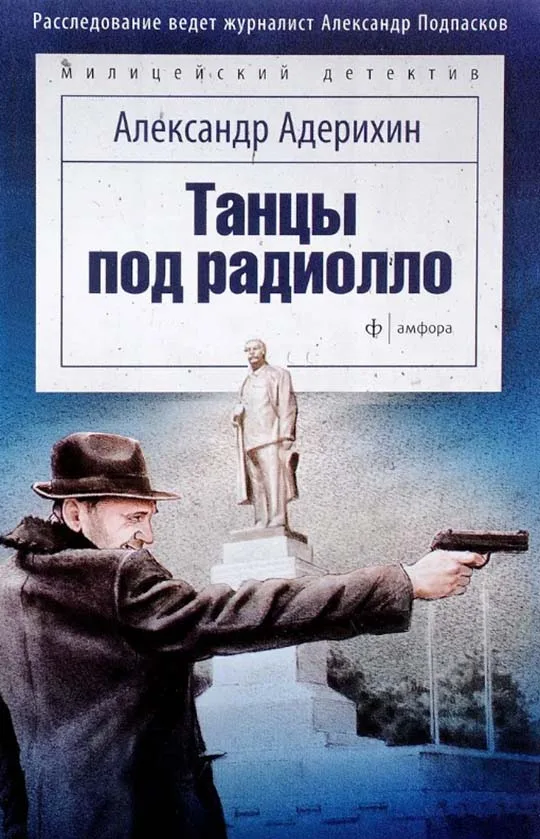
From the very start, "Dancing to the Radiollo" skilfully passes itself off as a detective story. Though one with a not entirely ordinary plot. The fighting pen of Soviet journalism, the leading writer of an unnamed but clearly very authoritative Soviet newspaper, Aleksandr Podpaskov, is sent on assignment to the Kaliningrad Region, just recently wrested from the Germans, which has not yet truly become Kaliningrad at all.
Rather, the region is a strange, at times downright hallucinogenic reality, where the remnants of German Gothic and dense Prussian mysticism resist, as best they can, the advancing Soviet imperial style.
Podpaskov is dispatched into this "twilight zone" on an important and dangerous mission. Persistent rumours are creeping through the region that the Third World War has begun. Supposedly the Americans are already bombing Minsk in earnest and shooting down Soviet aircraft, while the Red Army is suffering losses near Ankara (the book was written long before today's political events, but rhymes with them surprisingly well). These rumours breed genuine paranoia. Frightened settlers flee the region to somewhere far away from the approaching front, which completely wrecks the country's leadership's production plans for the coming "five-year plan". Podpaskov has to deal somehow with the panic among the region's inhabitants (or, more precisely, write that all the fears are groundless) and get the frightened collective farmers and other "builders of communism" back to their workplaces.
But at times the journalist will have no time at all for his important state mission. The Soviet republic's new "war trophy" greets him in anything but a friendly way. In the forests you can easily run into armed bandits (the first shoot-out begins right at the railway station); the Kaliningrad Region of that time resembles something like the "pirate republic" from Rafael Sabatini's novels, to which criminal elements from all over the country are drawn as if by a magnet. But bandits are at least made of flesh and bone – an understandable and familiar evil that you could just as easily run into in Moscow as in Orenburg. The Kaliningrad Region, however, harbours dangers that are completely unexpected for a mind brought up in the spirit of dialectical materialism.
An eerie mysticism – the notorious historical background of East Prussia, which this land will apparently never shake off – literally grows here out of the cracks in the asphalt.
And Podpaskov will have to try very hard simply not to lose his mind.
An unusual plot for the detective genre, one that does not fit the familiar formula à la "the gardener did it", will keep you in light suspense and surprise you with unexpected twists right to the end of the book. The ending will surprise and stun the reader (especially one used to the strict and clear templates of the detective genre) in its own way, while turning out to be entirely logical.
The first thing to understand about the plot of "Dancing" is that, unlike most modern specimens of the genre, it was not taken out of thin air.
The author himself says that 90% of the material is real, and that he sometimes had to sit for four hours in the local archive simply to make his characters' speech sound realistic.
Right after the war, such rumours about the start of a new military conflict really did circulate in the region. Their origin, it is true, differs slightly from the one given in the book, but the author, of course, has the right to fiction. And Aderikhin even has a genuine archival note about it.
"The rumour was so real that propagandists (including army ones) were sent to the large towns to tell people that there was no war", says the author.
Having guessed right by chance with Turkey as the geopolitical adversary, the author leaps beyond the bounds of so-called "genre fiction". Russian news bulletins, which in the last days of 2015 were filled with a paranoid search for an external enemy and a rather crookedly constructed conspiracy theory, turned "Dancing to the Radiollo" all by themselves from "entertainment" prose into "social" prose.
"I didn't set myself such goals – drawing a parallel with today's situation. But nevertheless it turned out that way: the parallels are there. People haven't changed much", explains Aleksandr Aderikhin, adding that he hopes his book will not turn into a prophecy.
Willingly or not, the author shows clearly to what boiling point an obsession with war can bring a society. The rumour, once launched, begins to snowball, gradually turning the entire region into a collective madhouse. Some people skilfully take advantage of it: servicemen wheedle goods out of the market women at lower prices, arguing that they will soon be leaving to die at the front. Some of their fellow soldiers, however, react to the subject far more painfully: a whole company goes to a fortune-teller, trying to find out whether or not they will survive the new slaughter.
The Soviet press plays no small part in this schizophrenic nightmare about the Third World War: Podpaskov soon discovers that he will have to fight practically against himself. The newspapers are simply obsessed with the desire to expose "militant American imperialism" and its "henchmen". As a result, "the seed falls on good ground": thanks to the media, people were so ready for "America is about to attack" that they take an absurd rumour for real information. This brings "Dancing" even closer to the present day, in which the media have long since become one of the main weapons of information warfare.
Aleksandr Aderikhin explains: "That's exactly what happens in the book – a direct parallel with what is happening now. I meet a friend. He complains that a doctor gave his child the wrong diagnosis, complains that a traffic cop stopped him and he had to pay his way out. But then he starts saying: 'Oh well, it's fine, if only we could chase America off to the North Pole.' In other words, he's having a hard time, the local bribe-giver officials are fleecing him, but he has a supertask – to chase America off to the North Pole, and then there will be happiness. After that the doctors will start making correct diagnoses, stop taking bribes, and everything will be fine for us."
Yet Aderikhin's book is interesting not only because it gives a perfectly clear picture of how a talentedly launched media virus can paralyse an entire society.
"Dancing" has a far greater claim to the title of "literature about the Kaliningrad Region" than most of the books published at the expense of the regional budget under the programme of the Kaliningrad Region government.
If for local poets the region is, as a rule, forests mixed with fields and the seashore (that is, a set of images that could just as well be identified with other regions of Russia), in Aderikhin's book the context of Kaliningrad-Königsberg is perfectly recognisable. You can't mistake it for anything else.
Here the Muscovite Podpaskov discovers a Hans Christian Andersen fairy tale suddenly come to life. But under the skin of this almost toy-like European architecture, preserved here and there, lurks "The Sandman" by Theodor Amadeus Hoffmann – one of the most eerie and nightmarish tales by the famous Königsberger. The old woman who keeps the floor in a plain Soviet hotel looks suspiciously like a toad, and later she even sprouts herring heads (which, naturally, try to devour the protagonist).
The whole Kaliningrad reality here is literally woven from dreams (which Podpaskov starts having with enviable regularity in his new place) and hallucinations. In the novel "The Last Soldier of the Empire", Aleksandr Prokhanov managed perfectly to show the painful reaction of a Soviet person to the new reality of the 1990s: the whole of space turns into a hallucinogenic nightmare, bats and other monsters fly across Red Square, leaving a thick layer of droppings behind them. Aderikhin subjects his protagonist to roughly the same torture as Prokhanov does, only here the reaction is not to the "collapse of the empire" but, on the contrary, to a new piece of it that has not yet been fully installed.
Too many things prevent the Kaliningrad Region from turning into a typical greyish Soviet province, where the proletariat goes to the factory in the morning and comes back from that same factory in the evening. Too much is reminiscent of some fairy tale and miracle.
The imperial style slowly begins to take its toll, unifying everything and everyone: streets and settlements receive new names (which now correspond to Soviet rather than German mythology). But for the time being even the settlers get confused by them and prefer to find their way by the German place names. And even the high command capitulates before Prussian mysticism and, when science proves powerless, turns to ancient magic.
In real history the Soviet style did defeat "Königsbergness". And it is well known by what methods: the streets did get new names after all, and the Royal Castle, as one of the main "enemy" symbols, was simply blown up. But even the formidable Soviet machine failed to crush this mysticism completely. In the 1990s, when the Union collapsed, interest in the historical heritage of Königsberg flared up again in the region, now on an entirely legal basis. Including in that part of it which was more reminiscent of the plots of third-rate American horror films than of historical truth. The existence on Kaliningrad television of the spooky programme "Secrets of the Königsberg-13 Laboratory" only confirms this. And although its author, Sergey Trifonov, has by now vanished from television screens, many regional media still gladly quote stories about his desperate (if never successful) searches for the Amber Room.
"I simply wanted to show a kind of interpenetration of two cultures. Our people arrived, and for them a sort of hallucinogenic reality begins. As in any city, there are myths and legends here. There are a great many Catholic legends connected with the Order. They are stunning in their Gothic quality: the Prussians burn knights in their ceremonial robes, and a white dove flies out of their mouths – the symbol of the Virgin Mary", the author of the book sums up.