
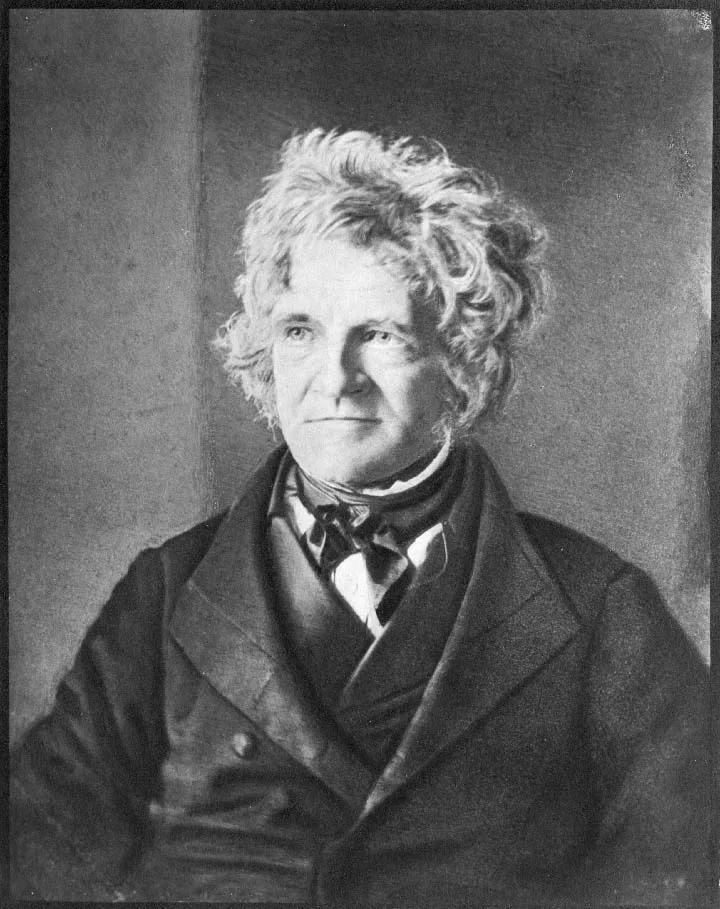
Today we know that the Earth's equatorial diameter is 12,756 kilometres and its equatorial circumference 40,076 kilometres. We owe these figures to the geodetic and geophysical work carried out in 1831–1834 by the great astronomer Friedrich Wilhelm Bessel, who began his first observations in Königsberg on 12 November 1813.
In 1826 Joseph Fraunhofer in Munich supplied him with the first large German heliometer, and with the help of this instrument Bessel determined the parallax of the star 61 Cygni and found that its position relative to other stars changes by 5 seconds a year. On this basis he calculated the distance from the Earth to this star, which came to 11.1 light years.
Although Bessel was not a native of East Prussia, having been born on 22 July 1784 in Minden, Königsberg can be proud that the great scientist spent almost his whole life here.
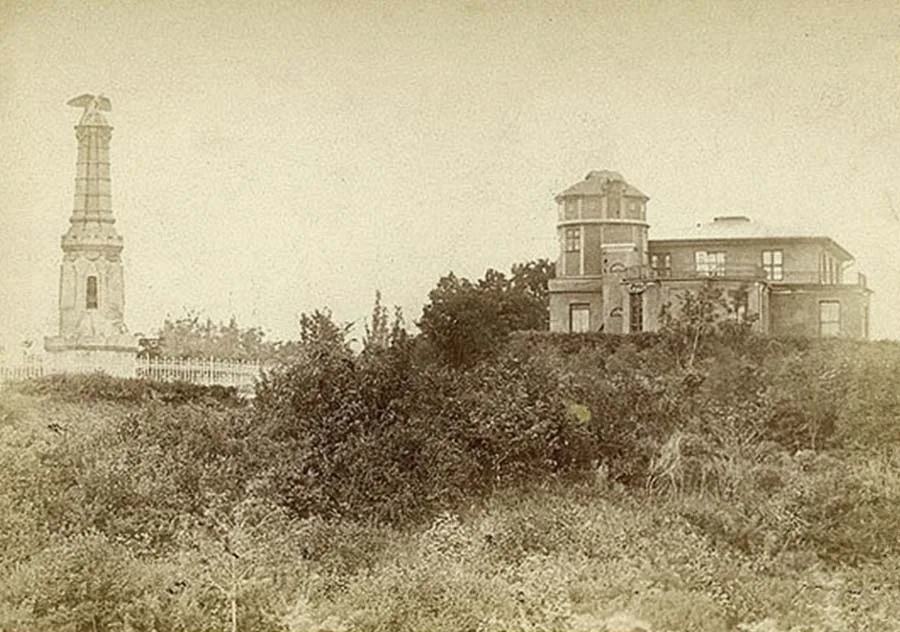 The Königsberg Observatory and the monument to the heroes of the Franco-Prussian War.
Bessel was originally a Bremen merchant who studied mathematics and astronomy privately. In 1806 he gave up commerce and became inspector of a private observatory near Bremen. While working there, his publications drew the close attention of the scientific community, which was one of the reasons why an observatory was built in Königsberg especially for him, a twenty-seven-year-old astronomer. This came about on the proposal of the prominent Königsberg figure Heinrich Ludwig Nicolovius and at the insistence of Wilhelm von Humboldt, who at that time headed the department of culture and education as a privy councillor in the Ministry of the Interior.
In 1809 Humboldt lived in the Saturgus house (im Saturgusschen Hause) and knew Königsberg at first hand. He understood that the importance of a state is determined precisely by its scientific achievements.
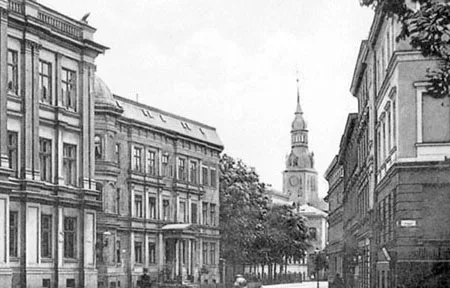
Originally the plan was to place the observatory in the main tower of the castle, and then on the top floor of the library building on Königstraße in Neue Sorge.
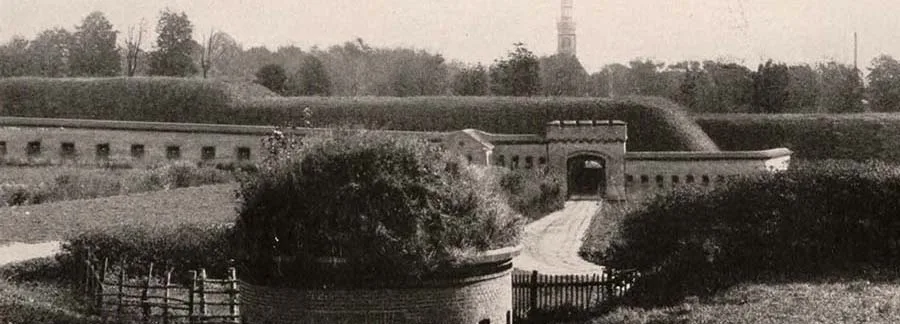
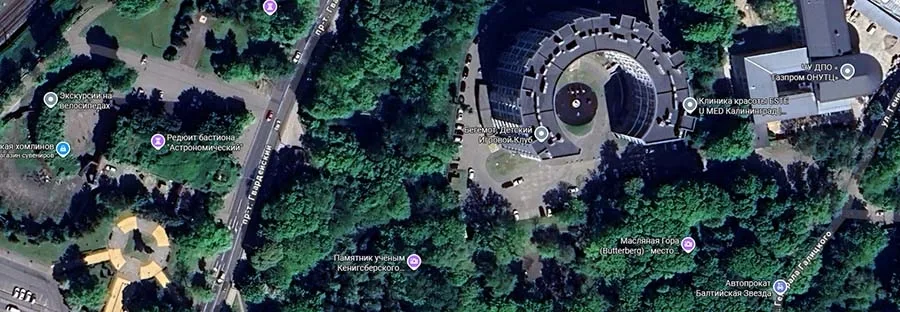
In 1811–1813, however, the "stargazer's tower" was built neither in the centre nor to the east of it, but in the west. It was erected on one of the hills, popularly called Windmill Hill (Windmühlenberg) but officially known as the Butterberg bastion (Butterberg, literally "Butter Hill"), whose history goes back to 1626, when it was built on this site to a design by Valerian Müller. Before the bastion there had been a gallows here, and later a windmill. Today's Bessel Square was originally named Mill Square after it.
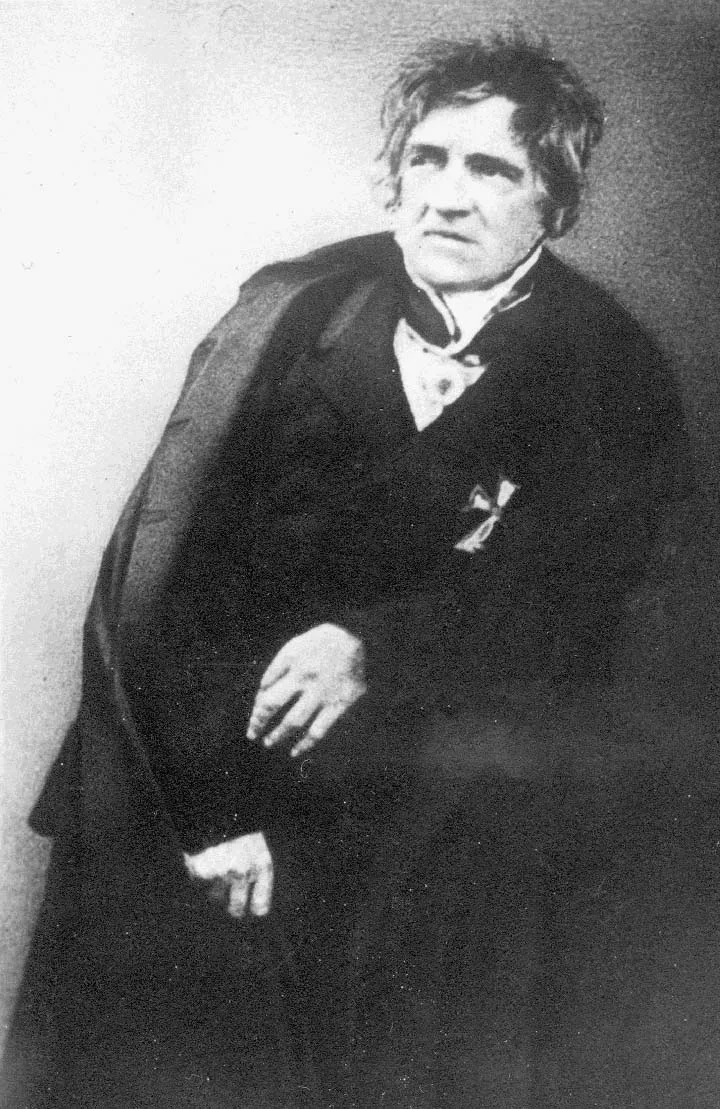
Bessel with the Danish Order of the Dannebrog (daguerreotype, 1843).
Bessel came to Königsberg in 1810. On the way he paid a visit to the great mathematician Carl Gauss, who said to him: "So you are now a professor in Königsberg. There are very able people there — stick together!"
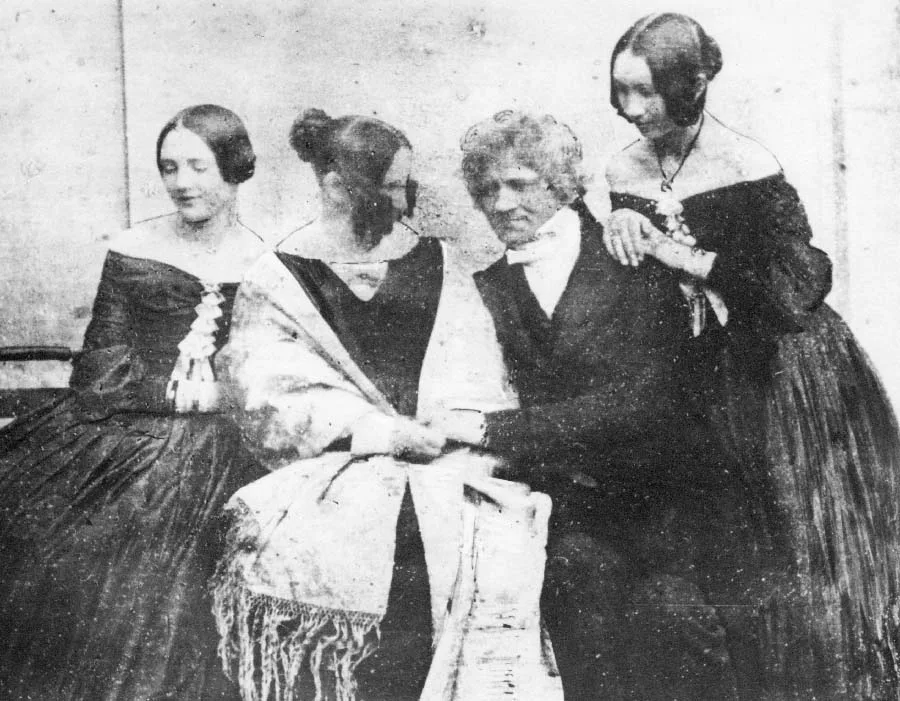 The family of Friedrich Bessel (daguerreotype, 1843).
The old war councillor Scheffner, a friend of Hippel and Kant, describes the laying of the observatory's foundation stone in his book "My Life": "The day before yesterday (24 May 1811) I was invited to throw a trowel of mortar onto the foundation stone of the observatory, which is to be built next to the Botanical Garden. In the time capsule, besides a brief note on the present state of science in Königsberg, the following short poem of mine was also placed:
Zur Zeit, da jeder Stand- und Messpunkt auf der Erde
Verrückt war, da sprach unser Friederich,
Der Recht und Wahrheit liebt: 'Es werde
Die Sternwart' hier gebaut, damit der Preuße sich
Am Himmel in das Laufen aller Sterne,
Ohn' sich zu irren, finden lerne.
Denn so lang' Bessels hier den Horizont beschauen,
Kann man ganz dreust den Sternen trauen».
This construction did not go unnoticed. In 1812 the world conqueror Napoleon found it untimely. He is said to have remarked on the subject: "Does the King of Prussia really have so much spare money that he can afford to think about such things now?!"
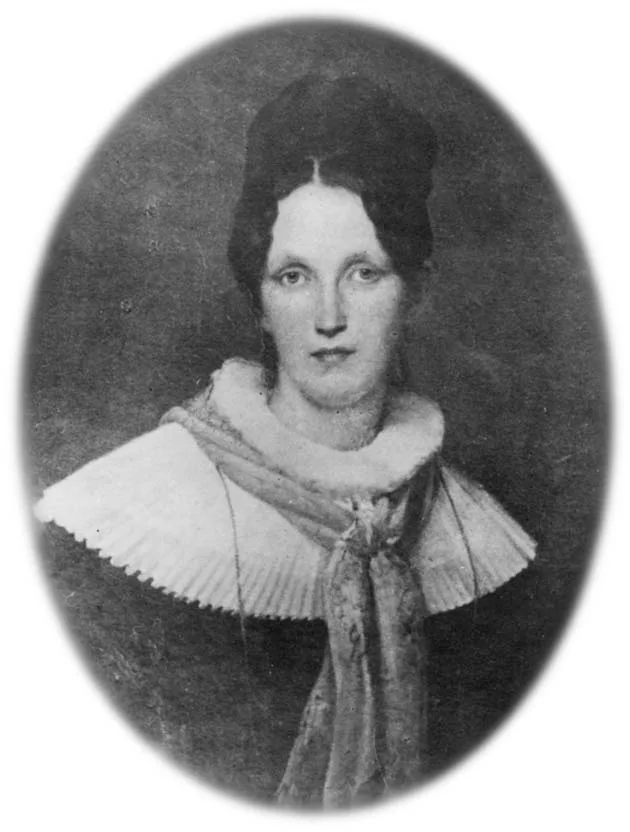
Johanna, Friedrich Bessel's wife.
The observatory was Bessel's workplace. He himself lived nearby, in a house resembling a small villa. This house remained the residence of the observatory's director until the destruction of the city by British phosphorus bombs on 29/30 August 1944.
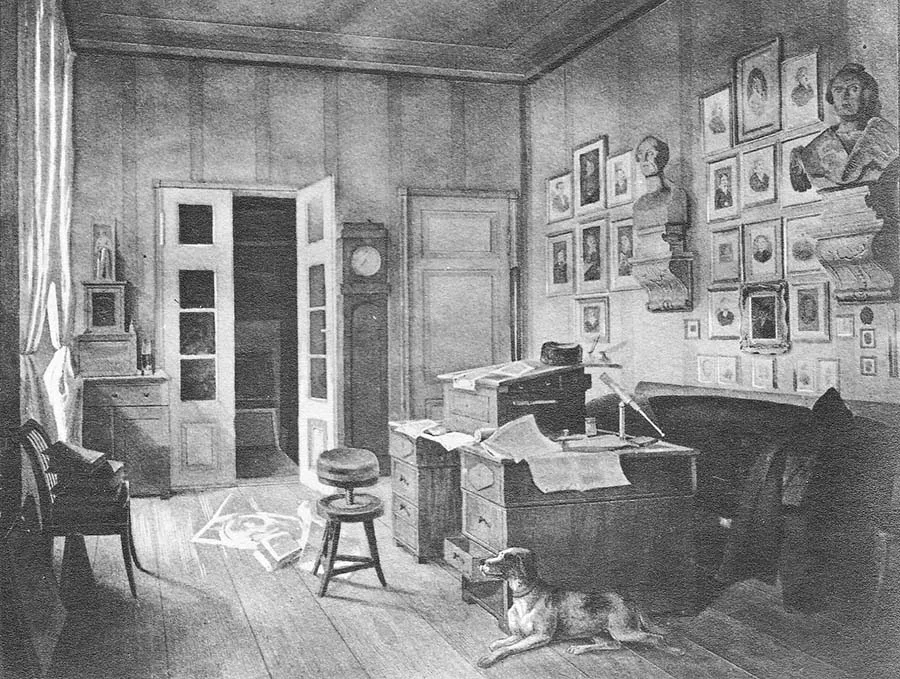 Bessel's study was located in the observatory building.
Bessel became so attached to our city that he even turned down the highly honourable offer to head the Berlin Observatory.
The great scientist's versatility is shown by the fact that, besides spherical and physical astronomy, he lectured on pure mathematics until 1829.
In April 1829 the 45-year-old Bessel played host to the celebrated Alexander von Humboldt, who at the age of 60 was setting off on his great Siberian expedition. He wrote to his brother Wilhelm: "Königsberg, 16 April 1829…
Here I am living with the cheerful and amiable Bessel in the observatory that you built. This morning I again made magnetic observations with him".
To our great regret, on 17 March 1846, at the very height of his scientific work, cholera cut short the life of the outstanding astronomer. The undertakers did not have to carry the coffin far: Bessel's remains were buried in the Scholars' Cemetery (Königsberger Gelehrtenfriedhof) directly opposite the observatory.
As for Bessel's personality, we have old Scheffner's flattering assessment from 1816 (ibid.): "...the observatory, built in a very convenient place, has found in Professor Bessel an incorrigible enthusiast of astronomy".
And in 1846 Dr Alexander Jung called him "the greatest astronomer on earth, whose gaze penetrates to sublime and eternally enduring goals".
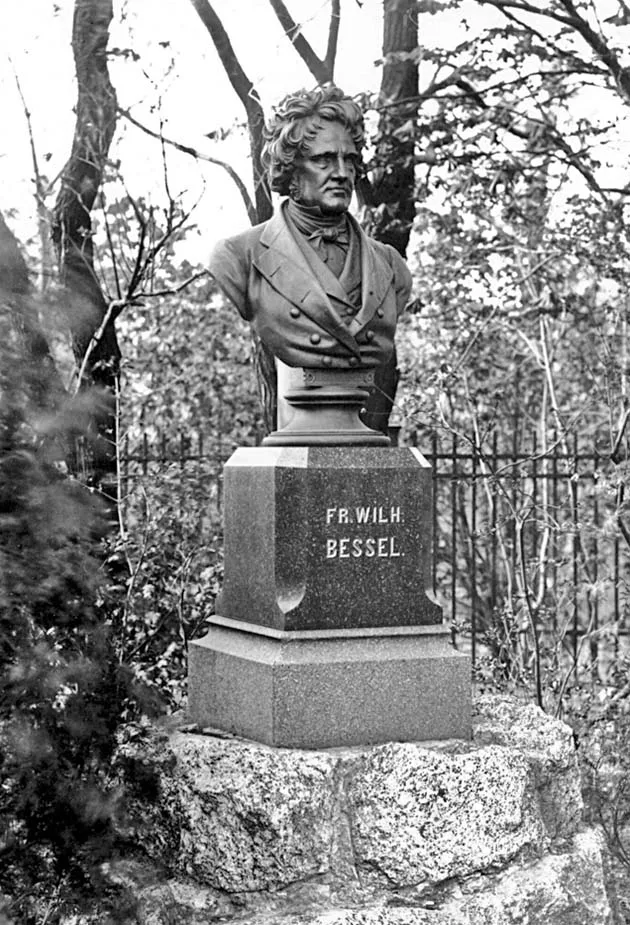
Bust of Bessel by Friedrich Reusch in the observatory garden.
By nature Bessel was a very reserved and private person, yet he warmly took under his wing those students whom he considered talented and purposeful.
In the liberal student movement of the 1840s, although with considerable restraint, he essentially sided with people such as Rosenkranz, Burdach and Lobeck.
Shortly before the beginning of the 20th century a bust of Bessel was installed in the observatory garden. The sculptor Friedrich Reusch (Friedrich Reusch), who created many sculptures for Königsberg, modelled it and cast it in bronze. At the beginning of the 20th century the New Observatory was built, from which on cold nights one could also observe the movement of the constellations — though, of course, not as successfully as Friedrich Bessel had done in his day.
PHOTOS
Bildarchiv Ostpreußen bildarchiv-ostpreussen.de.
SOURCE
Ostpreußen-Warte / 01 vom Januar 1959
● Editor's note: read on VisitPrussia.com an interview with the translator of German and, in particular, Prussian fairy tales, our regular contributor Tatyana Kolivay, who runs her own blog, where countless other parables, legends and fairy tales in her translations have been published.