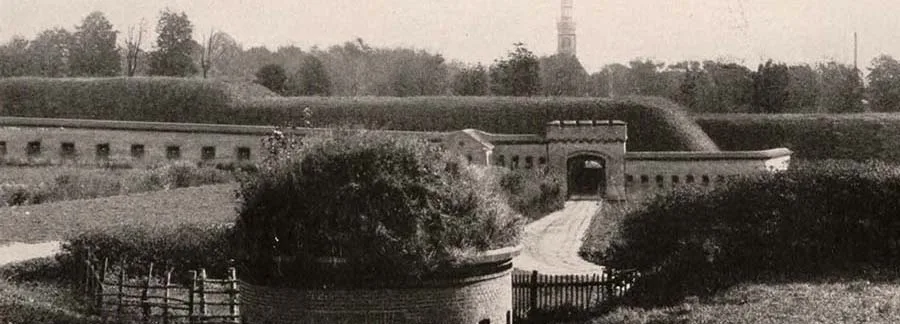


Violet Hill (Veilchenberg) was the name of a majestic grass-covered hill outside the Ausfall Gate (Ausfalltor), through which a road led west towards Pillau. At its foot stood the old inn “Neue Bleiche” (Neue Bleiche), popular at all times. People came here on Sundays, because for this establishment, as for all such little restaurants in Hufen, beyond the King's Gate in Kalthof, and indeed everywhere in the countryside, the saying held true: “This family knows how to brew coffee” (Die Familie kann Kaffee brühen). We children, however, did not go into such subtleties. For us it was a huge pleasure to stand at the fence and wave to the trains slowly heading for Juditten or Metgethen. The passengers, in turn, probably enjoyed seeing laughing, happy children in bright Sunday clothes waving to them.
So, if in 1898 you set off on a long walk out of town, past the People's Garden, where the old observatory stood, through the gloomy Ausfall Gate, in whose dark tunnel pedestrians' footsteps echoed loudly, then past the waterfall on the fortress moat (it seemed to pour straight down from the sky!), and then climbed the long ridge of Violet Hill to its very top, a delightful panorama of the surroundings, the Pregel River and the lagoon opened up before your eyes.
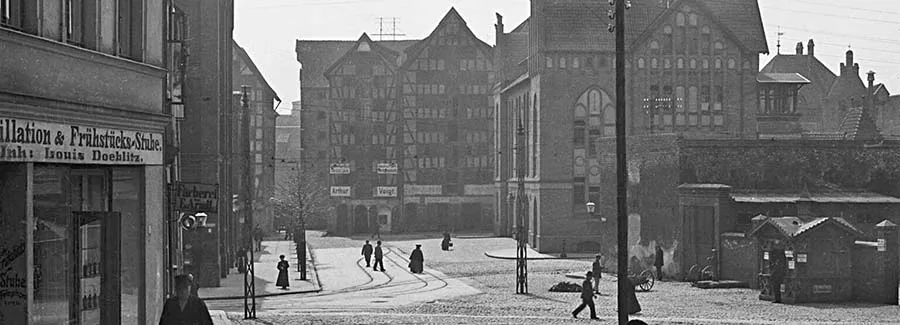
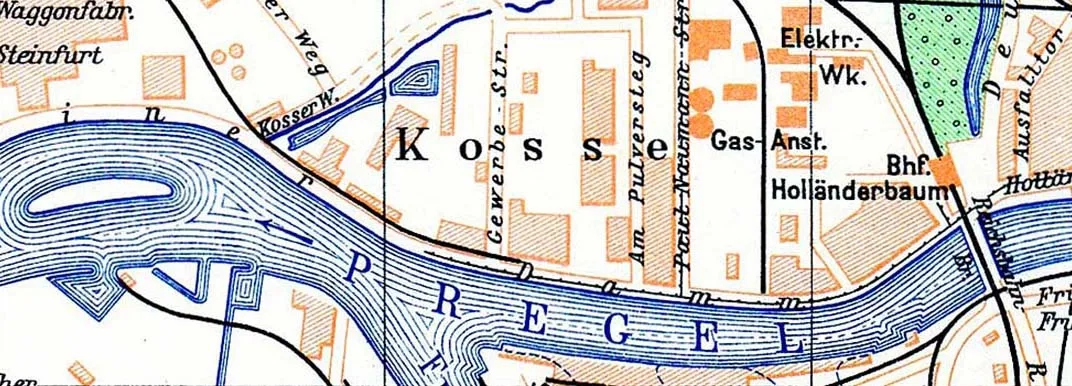
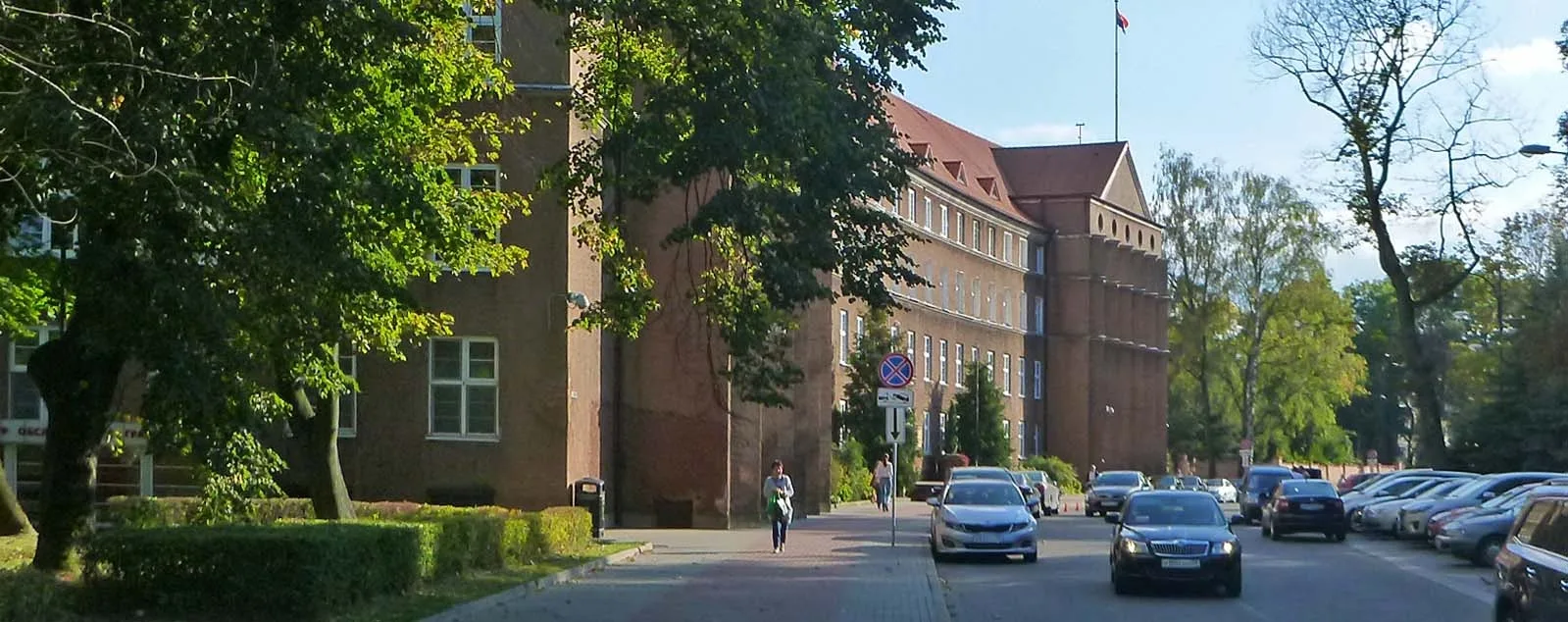
At that time there was not yet the imposing viaduct later thrown across the deep Hufen ravine (Hufenschlucht), nor the university psychiatric clinic that now stands on the waste ground where grain once grew, nor the power station, the tram depot, the gasworks, the cold store, the railway station, nor the bobbin factory. All these structures appeared some forty years later. At that time the even line of the horizon was broken only by the huge grain elevator (Kornsilo) and the roller mill (Walzmühle). These buildings, erected at the end of the 19th century on the initiative of the head of the merchants' guild, Richard Posselt (Richard Posselt), were admired as a marvel of engineering, for our elevator was then the largest granary in Europe!
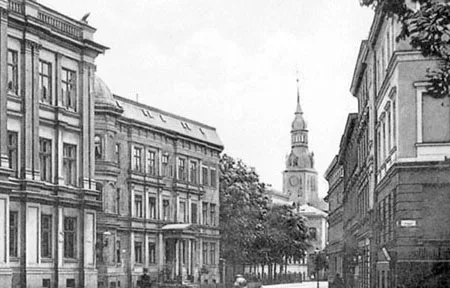
To the east, the towering belfry of the Neurossgarten Church (Neuroßgärter Kirche), with its huge clock and handsome Romanesque-style dome that served as a landmark for fishermen on the lagoon, rose out of the greenery. To its right, beyond the fortress moat, the modest track of the Lizent Railway (Lizentbahn), built in 1865, disappeared into a tunnel.
Far below, on the path to the gentle embankment in front of the outer moat of the fortress, closed to civilians and later popularly called the “Black Path” (Schwarze Weg), where beautiful Canadian poplars rose high into the sky, stood a small building. It was guarded by a soldier in a blue uniform and a gleaming spiked helmet, with a rifle on his shoulder. This was the powder magazine; today we would call it an ammunition store. The Powder Footbridge (Pulversteg), linking Cosse with the left bank of the Pregel, took its name from this building. Whenever I saw the sentry, I remembered the poem by Hauff (Wilhelm Hauff, 1802–1827) about a soldier silently standing guard in the dead of midnight.
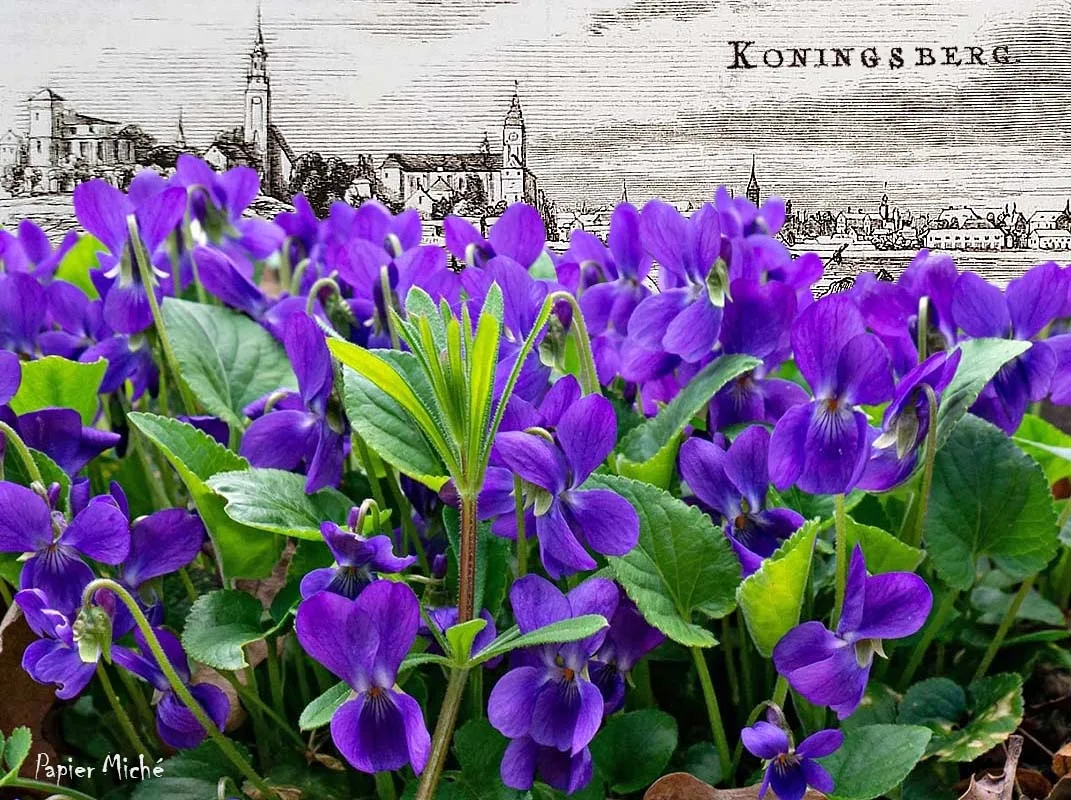
In those days Violet Hill lived up to its name: in spring it turned completely blue with violets. The people of Königsberg, however, proved merciless to these beautiful harbingers of spring, which within two decades led to their almost complete destruction.
Long ago this place had a bad reputation, because the Altstadt gallows stood there. It appeared on Violet Hill when the earlier places of execution on the Büttel Square (Buttelplatz), the Straw Market (Strohmarkt) and the Square of the Three Gallows (Platz an den drei Galgen), which later became the Hay Market (Heumarkt), found themselves within the city limits.
It was from Violet Hill that in 1910 we watched Halley's Comet, the very one that had been so eagerly awaited and that all the newspapers wrote about. It was believed to have once been enormous. But, alas, by the time this heavenly body appeared in our sky at the appointed hour, it had lost most of its beautiful long tail somewhere in distant space and was now only a pitiful shadow of itself, yet still the only comet I have seen in my life.
In the 15 years after the First World War, when Königsberg, thanks to the far-sighted plans of the municipal building councillor Beuster (Fritz Beuster) and the talent of the director of city parks Schneider (Ernst Schneider, 1874–1968), turned into a beautiful and very green city, such as there were few at the time, Violet Hill too was transformed. Now it was buried in magnificent rose bushes, and from its top there were still stunning views. In winter our Veilchenberg became a place for outings and a paradise for skiers.
Let us hope that one day we will see it again!
Source: archiv.preussische-allgemeine.de
LEGENDS OF PRUSSIA on the blog of Tatyana Kolivay.