

First, the so-called Borstenstein — the "split", "cleft" or "bristling" stone, better known to us as the Stone of Lies — visually consists of a group of two stones. Second, no one knows what the "stone" looks like underground, since no geological, archaeological, geomagnetic or other scientific research has ever been carried out here. True, local enthusiasts have made attempts to "dig out" the stone, as the journalist Natalya Gorbachyova reported in good time in the "Kaliningradka" newspaper. Unfortunately, we do not know what the Prussians called this stone. Hardly "Reddan-Stabs" (a copy of the German Lugen-Stein, "stone of lies") — this function was clearly attributed to the stone at a later time.
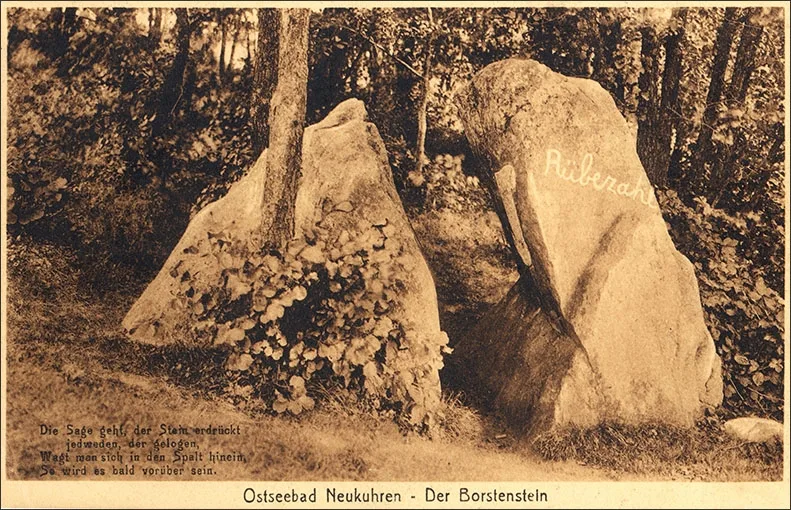
The Stone of Lies on a postcard from the early 20th century.
(Postcard from the author's collection).
The stone's special nature is betrayed not only by its outward shape but also by the landscape context in which it lies, and by folk traditions that seem to have recorded a more archaic function of this "structure". As already mentioned, it consists of two dissimilar parts which visually (and geologically?) appear to be parts of a single stone that was once split.
In the first of the two main legends about the Stone of Lies that have come down to us, as we shall see, the stone appears as a single whole. In the other it is already a cracked boulder whose parts come together under certain circumstances.
One part of the stone is a leaning cylindrical "obelisk", taller than a man, with several faces and triangular "notches" on two sides, and it has a "phallic" shape. The other part of the stone has visibly been less affected by human activity, but it has many holes resembling so-called "cup marks" — cup-shaped hollows of artificial origin. Can we say that the straight, clear-cut forms given to the right-hand (eastern) stone belong to a later period, and the left-hand (western) stone with its shallow cup-shaped hollows to an earlier one?
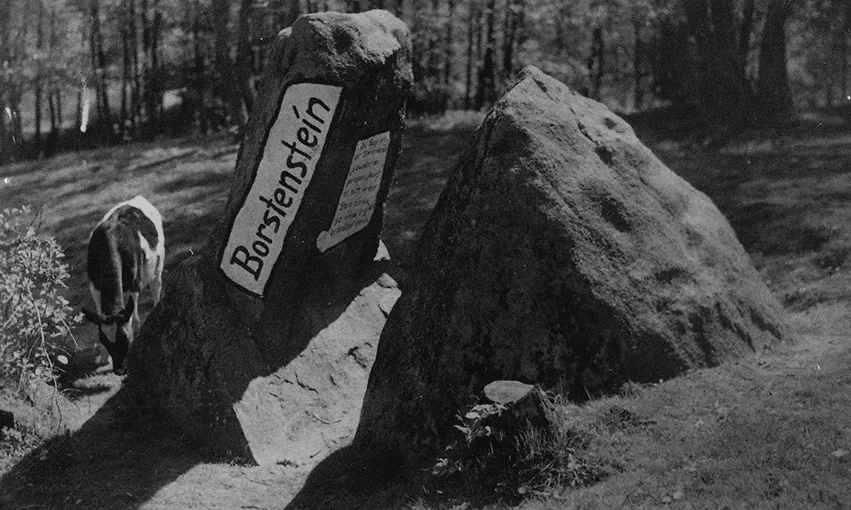
View of the Stone of Lies from the north, photo from the 1920s–30s. The painted inscription "Split Stone" can be seen.
Cup-shaped hollows can be seen on the western stone. Photo from the author's collection.
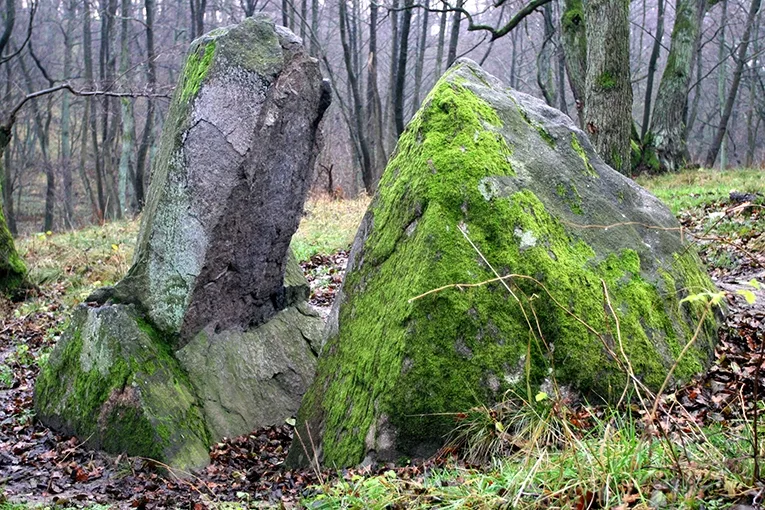
View of the Stone of Lies from the north, photo taken in February 2006.
Cup-shaped hollows can be seen on the western stone. Photo by Aleksandr Matveyev.
Archaeology
Although no archaeological research has been carried out around the stone, its location may lift the veil of mystery slightly. In the vicinity of present-day Pionersky, within a radius of a few kilometres of the stone, in Rantau and Alknicken (both near the village of Zaostrovye), there are several groups of Bronze Age barrows. The people who left them belonged to the West Baltic Barrow culture; these distant ancestors of the Prussians probably knew about the existence of this stone in the ravine two thousand years BC.
Perhaps it was they who completed the work begun by Mother Nature and gave the stone its shape? Or even set up the parts of the split stone here?
It can be said that the stone circles and burial chambers of the Bronze Age barrows are the only monumental stone structures in the West Baltic area (before the Prussian stone "babas" of the 11th–13th centuries).
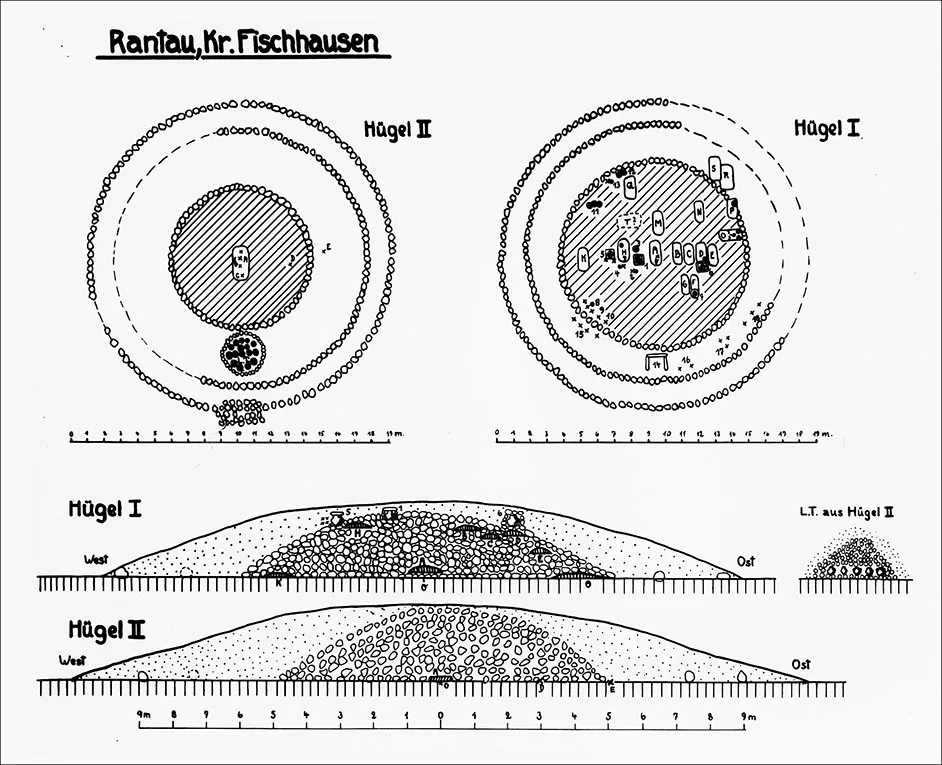
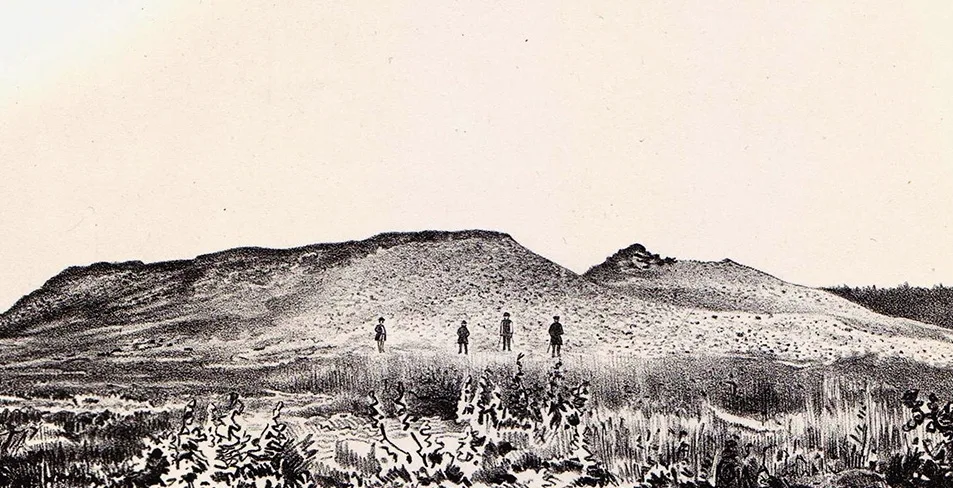
Stone structures and mounds of Bronze Age barrows in Rantau/Zaostrovye.
(Drawing by Carl Engel from the R. Grenz Archive, Schleswig).
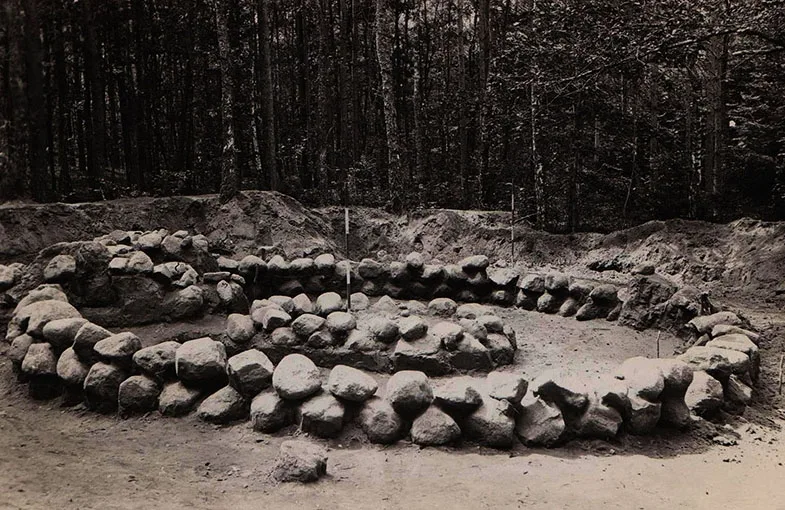
Stone structures of an excavated Bronze Age barrow, Georgenswalde/Otradnoye.
(Photo by Carl Engel, R. Grenz Archive, Schleswig).
Our split stone is somewhat similar to a "megalith" or "menhir" — which is why it stands out among the other so-called sacrificial or "devil's stones" discussed last time. At least the "left-hand" part of the stone, with its cup-shaped hollows, many of them largely "silted up" today, may theoretically date from the Bronze Age. These holes may have been made by "pilgrims" who came to the stone with prayers and offerings, perhaps in the same way as was done later on the bricks of the portals of medieval churches. Such stones were probably associated more with the chthonic, underground, "female" side of the manifestation of the sacred. Added to this is the stone's location: on a marshy hillside where rainwater collects and springs rise. But this stone also has a second half, which has an entirely different shape and probably a different interpretation.
In the area of Neukuhren (Pionersky) there are also later — Prussian — burial sites, dated to the Migration Period and the late pagan era (5th–13th centuries): the Hünenberg (Giants' Hill) in the southern outskirts and the burial ground near Palwe on the western edge of the town.
Perhaps our distant historical ancestors, who cremated their dead here and buried them with honours and sacrificial horses, knew the Stone and used it for their cult purposes. Perhaps it was they who gave the second part of the stone its clear geometric shapes?
The archaeological ornamentation of the Prussians of this period usually has strict geometric features. Or is it, after all, the work of Bronze Age stonecutters? Or of the early Middle Ages? It is hard to answer offhand.
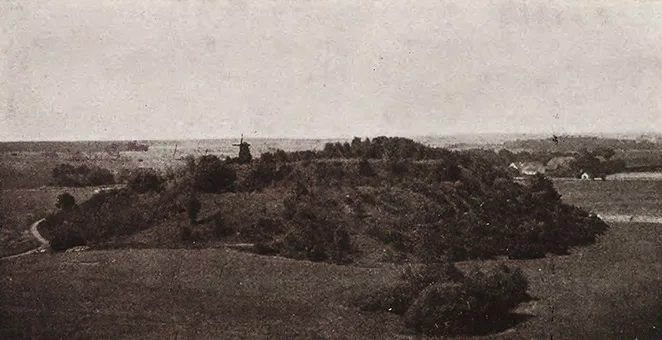
As was said at the beginning of the article, in the northern part of the valley lies the hillfort of Batau-Herrenwalde (the western part of Pionersky), which, like all the others, appeared here no earlier than the turn of the Bronze and Iron Ages, i.e. around 500 BC. The ancient engineers gave the projecting promontory a clear triangular shape and made effective use of the ravines of the stream flowing here. It seems that a rampart was heaped up on the southern side, a ditch — now shallow — was dug on the east, and the sides of the promontory and of the ravines surrounding the site were scarped (cut to a slope). An earthen ramp leads from the hillfort down into the valley; it probably served as the entrance to the valley and the approach to the Stone.
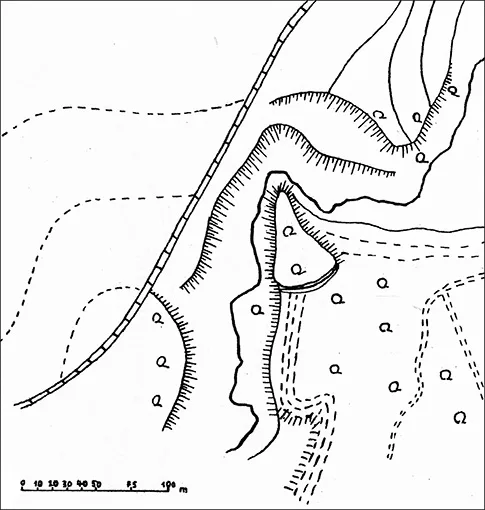
Plan of the Batau-Herrenwalde hillfort.
(Drawing from H. Crome's article of 1940).
Incidentally, to Oskar Schlicht, the expert on Western Samland, other glacial escarpments in the valley also seem to have been adjusted by people who, for some reason, made them even steeper and more inaccessible. What, then, were they hiding in this valley? The stone, a sacred stream or an entire cult complex?
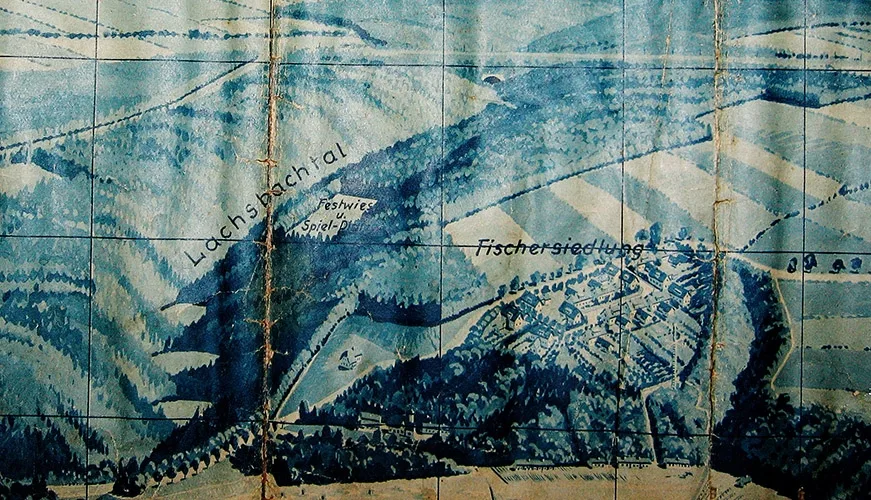
View of the Salmon Stream valley on a pre-war map.
(From the author's collection).
In the southern part of the valley, also bounded by glacial slopes, a large flat-topped stone resembling the cult sacrificial stones of the Balts was discovered during a survey of the area in spring 2005.
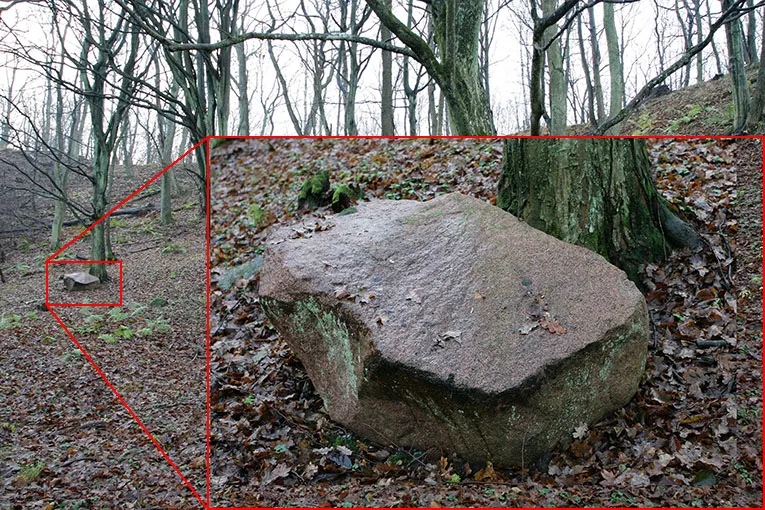
The stone discovered in the southern part of the Salmon Stream valley.
Photo by Aleksandr Matveyev.
The stone is not mentioned in pre-war publications and reports. Whether this flat stone lies here in situ (Latin for "in place") or was thrown down the slope is unknown. Travelling through the Salmon Stream valley, you can notice many small and quite large stones scattered here and there along the stream. Once there were more stones here — they were used for building purposes. Oskar Schlicht mentions a folk tradition according to which these stones grow up out of the ground, and if such a stone is disturbed or dug out, the growth stops.
And what do other legends say about the Stone?
Ethnography and folklore
This is what R. Reusch, a collector of Sambian tales, managed to learn about our stone; he published the legend "The Split Stone near Neukuhren" in 1863:
"Many years ago the son of a peasant from Neukuhren became apprenticed to the local tailor, and came to love not only his craft but also his daughter. One day he set off on his travels. The girl accompanied him through the beautiful valley leading from Neukuhren to Tykrehnen, as far as a huge granite boulder. Here they said goodbye, but before that they swore to be faithful to each other, inseparable like this stone. When the tailor returned from his wanderings, his beloved was waiting for him at the same stone. He raised his hand to heaven and swore eternal faithfulness to her. But when the girl raised her hand to swear, a terrible bolt of lightning with a bright flash split the granite boulder from top to bottom. Thus the tailor learned that his bride had not been faithful to him. Later he took another girl for his wife."
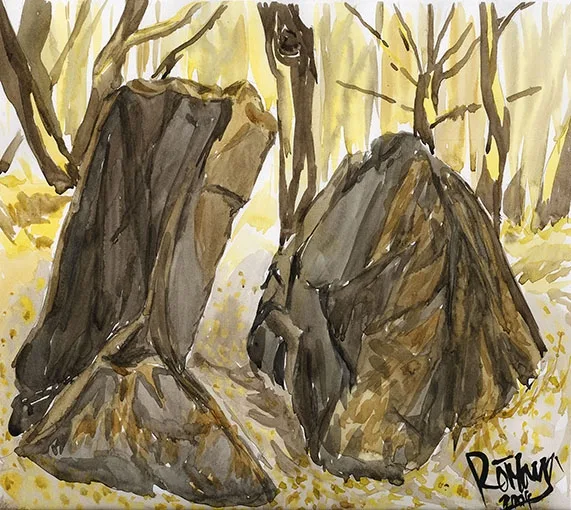
"The Stone of Lies".
Watercolour by the author, October 2004.
In later versions of the legend the young man and the girl swear faithfulness to each other at the split stone, and after the young man's return (from war, from fishing, etc.) they meet again, and when the girl passes between the halves of the stone, thunder strikes and the stone crushes the faithless girl. This is probably why the following explanation can be found in F. Borbstadt's article of 1931 on "stones of lies" and "gallows oaks":
"In the valley of the Salmon Stream near Neukuhren lies a large boulder known as the Split Stone or the Stone of Lies. In the middle of this stone there is a wide and deep cleft. The tale says that anyone who has once told a lie cannot pass through this stone, whose halves close together and crush the liar."
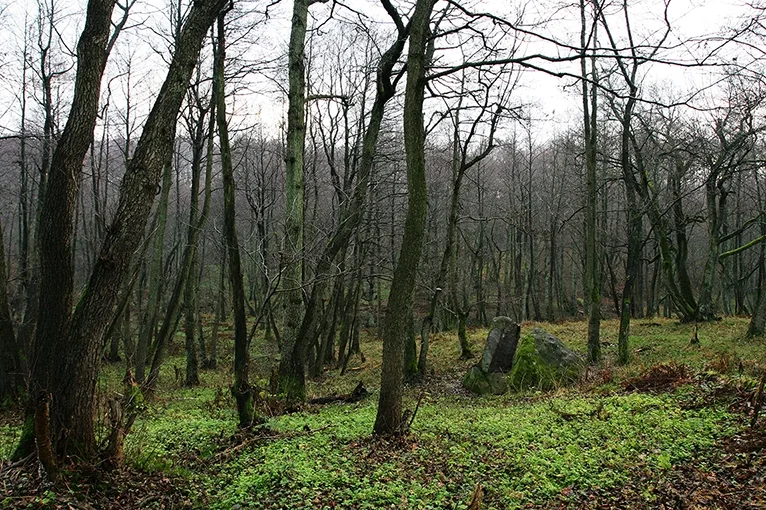
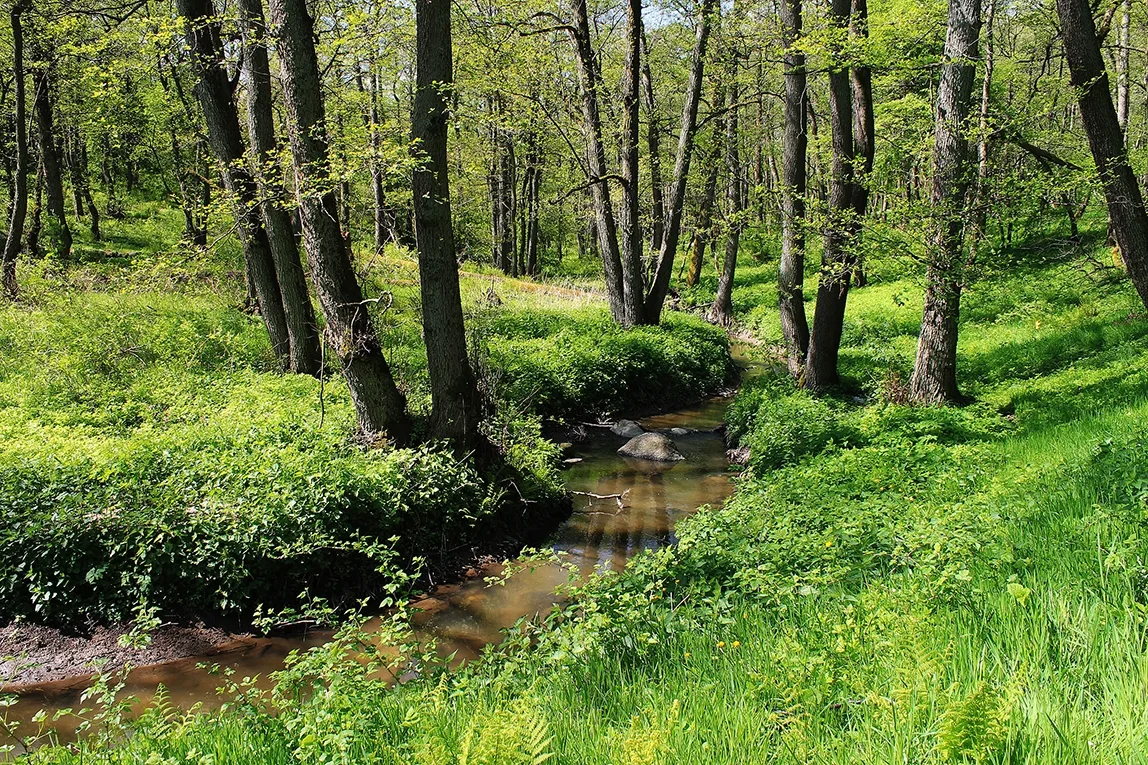
The Stone of Lies in the landscape of the Salmon Stream valley, February 2006.
Photo by Aleksandr Matveyev.
Let us look at the plots and motifs of these stories in more detail.
So, a young peasant decides to change his status, and with it his fate, and becomes apprenticed to a tailor. In the archaic mind, making and mending clothes is a magical profession. In Latvian folklore there are even tailor stones, at which people left fabrics, threads and offerings and in the morning collected the finished clothes. The young man falls in love with the tailor's daughter, and they swear an oath at the stone, which was surely known to everyone as a "place of oaths". The category of "faithfulness" hints at a marital relationship, and hence at a subsequent mutual change of social status.
Thus this stone may have been connected with some kind of "initiation" and may have been a place for "sealing agreements".
Then one of the characters in the legend breaks the agreement, and so at the moment of deception lightning strikes the stone — that is, Perkuns, the thunder god, also known as the god of justice, splits it — and the young man learns that the girl (his bride) has been unfaithful to him (has broken her oath). In the other version of the legend we learn that to seal an agreement one must pass between the halves of the already split stone, i.e. once again we clearly encounter the moment of transition, of initiation into some new state. The importance of initiation rites in the archaic rituals of pre-agricultural peoples, and especially for male communities, is emphasised by the historian of religions Mircea Eliade.
Here we encounter two archaic motifs: an agreement/oath at the stone, and initiation — the need to pass through the stone (later, a test), and to pass in such a way that thunder does not strike and the two parts of the stone do not close together.
And what about the girl? Why is it she who becomes the "victim" of the stone? Hardly because of the de facto low social position of women up to the end of the 19th century and the corresponding reference to the Old Testament. Perhaps in more ancient times women were not allowed to pass through this stone. Or allowed to pass through it only under certain circumstances. Perhaps bloody human sacrifices, known to the Prussians too, were once performed at the stone, necessary, in the notions of the time, to maintain "cosmic balance" and the fragile harmony of the agricultural cycles. Perhaps the central role in them was played by an unmarried woman, a maiden... In that case the Stone of Lies may in part have served as a sacrificial altar too.
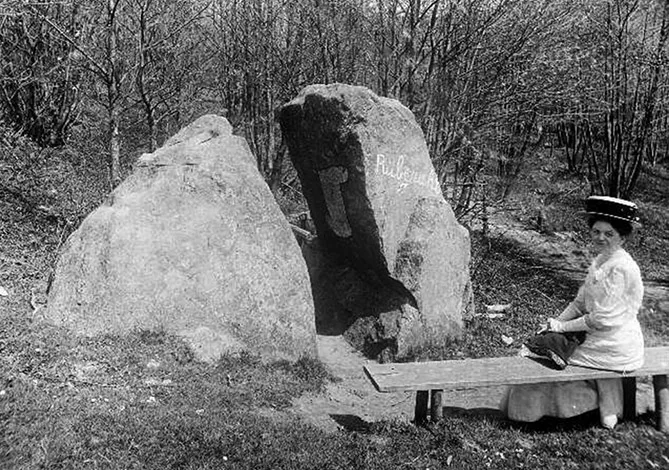
A girl posing in front of the Stone of Lies. Early 20th century.
Photo by Richard Detlefsen.
So the Stone appears as a kind of portal of initiation — a gateway to a new state. Unfortunately, we do not yet know anything about the cosmological significance of this monument. If we accept the idea that it was set up or adjusted artificially, was the passage between the stones oriented to the sun or in some other way? Nor do we know the geological details: did the stone split naturally (gradually, under the action of water and frost), gradually slide down the slope, or was it placed here deliberately? In any case, the passage in its central part hints at least at some "finishing work" and seems to have been widened artificially at some point.
The question arises: were the hillfort, the valley, the split stone in its centre and the flat stone in the southern part of the valley parts of a single whole — a sanctuary connected with an initiation rite necessary for the transition to a new social and ritual dimension?
The motif of lying or of breaking an oath is a cause for caution. The point is that "stones of lies" are occasionally found outside historical Prussia, in the German lands, and the emergence of such a characterisation is more often connected with the process of Christianising the pagan mind and landscape, as in the case of the stones in the Lippoldshöhle valley or in the town of Halberstadt (Saxony). The latter is also called a "devil's" stone. This point is interesting and may be of special importance in unravelling the mystery of the Sambian Stone of Lies.
At the same time, the shape of our stone is unique. The only analogy known to the author is in Latvia (thanks to Dr Juris Urtāns): Velnsakmens, the Devil's Stone in Postamuiža in the Aizkraukle district, which also consists of two parts of what was once a single stone, with a passage in the centre. The cup-shaped bulges on the stone were interpreted in the popular mind as the marks of the Devil's claws, and its split state as the result of the stone falling from his paws during an unsuccessful throw over the Daugava.
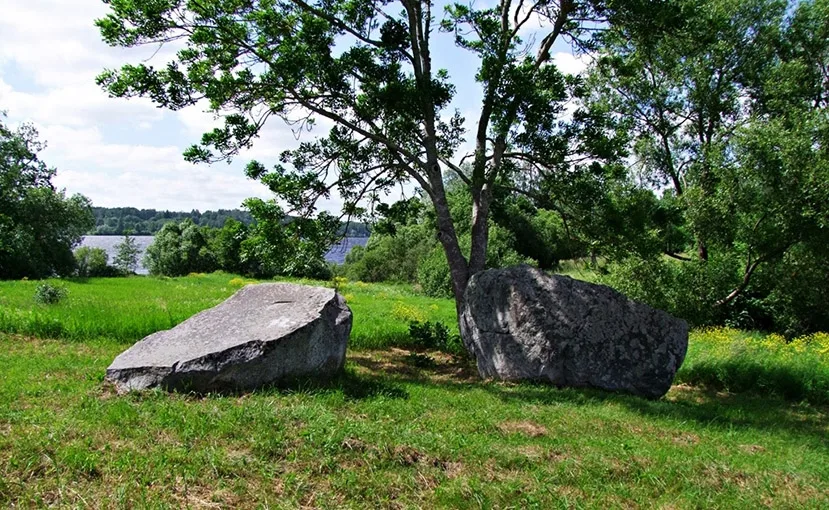
The split Velnsakmens (Devil's Stone) in Postamuiža, Latvia.
(Photo: www.megalithic.co.uk).
The phenomenon of this stone, its first mention in 1451 and the tales about it show that legends about "devil's" stones appeared in the territories of the Eastern Baltic conquered by the Germans quite early — as early as the 15th century, and possibly earlier. The Latvian Velns, like the Lithuanian Velnias and evidently the Prussian Patals — chief chthonic gods, patrons of the underworld — becomes the "devil" only in the process of the "de-chthonisation" and Christianisation of the region. This may indicate the particular antiquity of stones with cup-shaped hollows. Interestingly, archaeological investigations at the "devil's" stone in Postamuiža yielded no results. What if, when the split stone in the Salmon Stream valley is excavated, we too find no remains of burning and sacrifices? And what if we find something else?
If the Stone of Lies near Neukuhren once had chthonic functions of fertility, or even more archaic ones — connected with hunting and forest deities — then later it acquired new ones: a connection with the thunder god, and probably at the same time a new shape in its right-hand part.
One could even invent-reconstruct legends (no longer surviving?) based on others that exist in Latvia or Lithuania, about how a chthonic deity flees from the thunder god, who in the end splits with lightning the stone under which it is hiding (one of the main motifs of the "basic myth"), or else interpret the stone as having split after falling from the paws of the Devil, who left marks in the form of cup-shaped hollows on one part of it.
Joking aside, the stone is attracting more and more attention from local residents and visitors to the region today. People interpret the phenomenon of the Stone of Lies in different ways. Some consider it a portal to other worlds, others a lie detector and wish generator, still others a geomagnetic and bioenergetic anomaly that regenerates the chakras and restores feng shui. Some today believe that women must on no account pass through the stone (reasonable, judging by the legend), others that the stone promotes a successful pregnancy... And now people walk not only between the stones but also around them, three times, making a wish that "will certainly come true". Today benches for visitors have again been put up at the stone and litter is cleared away, while a nearby tree, hung with "Tibetan" ribbons, has gradually withered and fallen into the sleep of death. I liked one timid, yet not meaningless, interpretation of the stone's ancient functions from an old "Rodnover" I once met at the Stone. In his opinion, lovers on St John's Night passed through the stone, each half of which symbolised the male and female principle, and then ran down to the stream to bathe, and after that — you know the rest. A Prussian "yin and yang" of sorts...
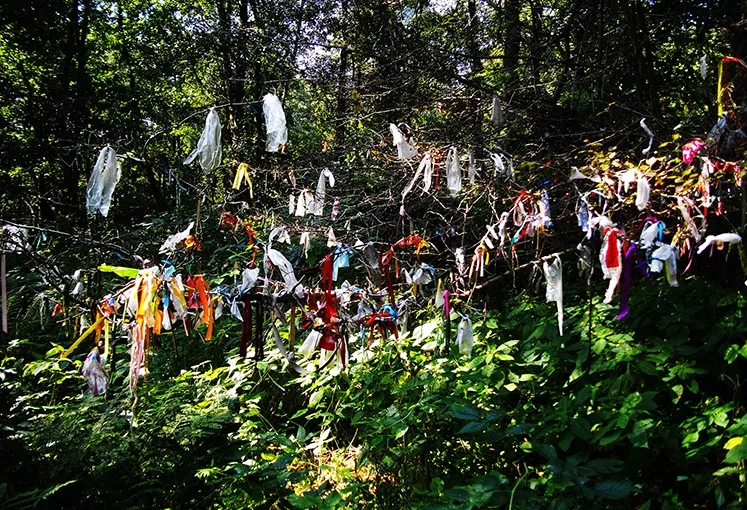
Ribbons on a tree near the Stone of Lies, summer 2015.
Photo by the author.
And yet the most important thing in understanding the "Split Stone" remains the development of this monument, which has survived a succession of epochs and, probably, of religions and the interpretations connected with them. In recent times ignorant people have covered the stone with inscriptions: Rübezahl1, the text of the legend from the postcard, and today pseudo-runes and nitro paint. Let us hope it will survive this too.
Let us sum up the preliminary results of our journey through time
– About 10,000 years ago the glacier, as a parting gift, carves out the valley and leaves a boulder on the slope, which probably gradually slides down. Under the action of cracks, precipitation and frost the boulder splits into two parts, standing out even more in the surrounding landscape. The appearance of this stone here can be explained differently: by the thunder god's pursuit of his eternal enemy, the chthonic deity (the so-called "basic myth"), or by a forced throw by the Devil.
– In any case, the stone may be connected with the Prussian Perkuns and Patals or their predecessors. Why? Read on. Permanent settlements in this part of Sambia appear no earlier than the turn of the Stone and Bronze Ages, that is, about 4,000 years ago. It was these people, standing firmly on their feet and no longer dependent on the forest as their few predecessors (who probably knew about the stone) had been, who could have been the first to endow the Stone of Lies with sacred functions and to give it a shape close to its present one: widening the "passage", leaving the cup-shaped holes and perhaps even working the right-hand or eastern boulder, giving it a phallic shape. These people mastered the technique of working stone, as the structures of their barrows confirm.
– In these and later pagan times the stone may have been used as a "gate"-portal for initiations connected with "rites of passage". And possibly for sacrifices (including human ones).
In a later period, with the emergence of a male aristocracy, the male component of the initiation ritual may have grown stronger, connected with the patron of warriors and of society as a whole — the thunder god Perkuns.
Hence, probably, the emphasis on thunder in the legend and the "unrighteousness" of the woman. Thus, in the Salmon Stream valley, roughly from 500 BC to the 1250s, there may have been a sanctuary whose key part was the Stone of Lies.
– During Christianisation the original meanings become mixed and lost, recalling the Stone's original functions less and less. Unfortunately, the stone is not mentioned in the Order's chronicles and documents, probably because the Order was mainly interested in the Prussians' loyalty and in their paying their taxes properly, without going into how good Christians they really were. Perhaps that is why some of the real motifs connected with the sacred functions of the stone passed through the "broken telephone" of the centuries and were recorded as folk tales in the 19th century.
– At the turn of the 19th and 20th centuries the Stone, like many other outstanding natural features and monuments, becomes a tourist attraction. Tourism usually "sacralises" everything anomalous and unusual, turning it into a "brand". Residents of and visitors to East Prussia willingly visit the stone and are photographed in front of it, and talk about Rübezahl and about how a "liar" will not pass through the stone.
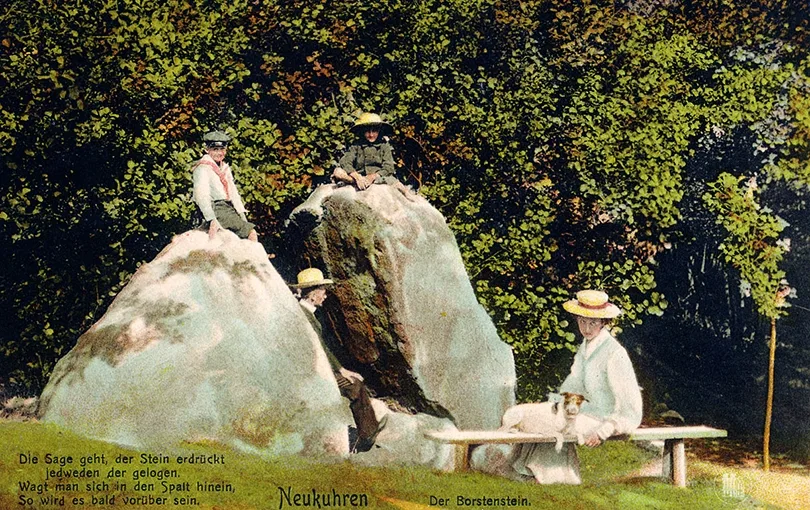
A family of travellers posing in front of the Stone of Lies.
Postcard from the early 20th century.
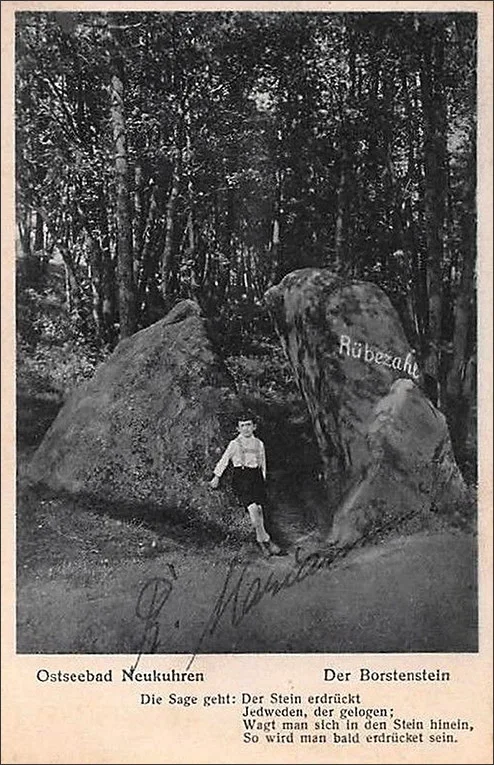
A boy posing in front of the Stone of Lies.
Postcard from the first third of the 20th century.
The rhyme on the postcard
This stone will crush to death
All who lie with their breath.
Pass, liar, if you dare,
Your end awaits you there.
– And finally, our own time. The stone increasingly attracts followers of an esoteric perception of the universe. Neo-pagans and New Agers, yogis and "Rodnovers". All those who have not fitted themselves into the paradigm of Orthodox everyday life and atheist hypercriticism, or simply "lovers of the ancient history" of our region, visit the Stone of Lies, paying their respects to it with a simple ritual of passing through, small offerings of burning icon lamps and bread, and retelling the distorted legend once recorded by Reusch.
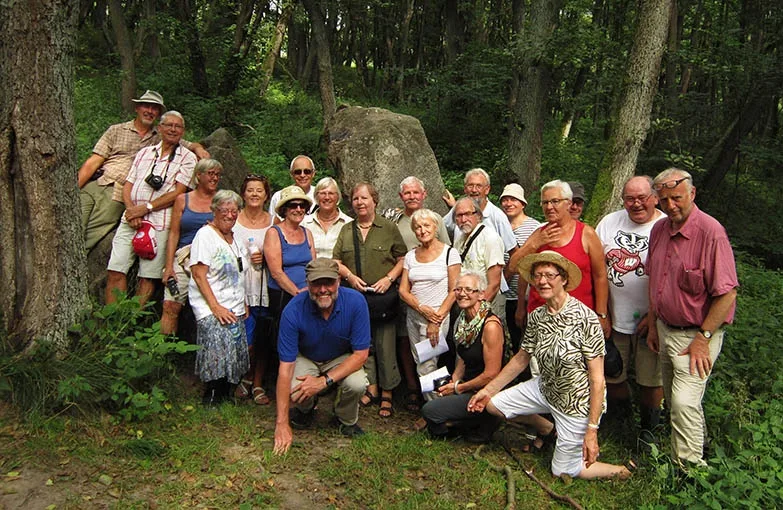
Members of the Danish amateur archaeology club "Harja" at the Stone of Lies, August 2013.
Photo by the author.
So what is the "Split Stone", the Stone of Lies? An ancient sacrificial altar, a portal of initiation or an ancient observatory? Or perhaps all of these together? It is hard to give a definite answer. And yet there is a suspicion that once, at this Stone, strange things took place, unthinkable for the modern everyday mind, things that cannot be grasped simply by studying it. Probably, as we pass through the cold cleft between the parts of this stone, we will never know what really happened here 1,000, 2,000, 5,000 years ago...
_____________
1. Rübezahl is a Germanic spirit of mountains and stones.