
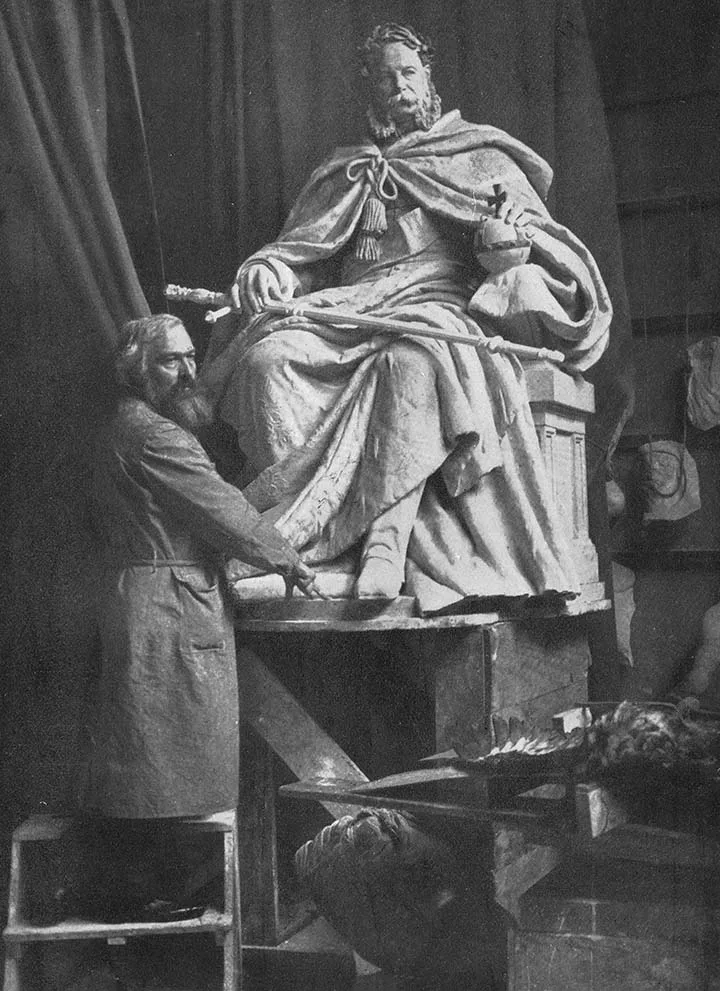
Siemering was a son of his time. His early works show the tradition that came from Rauch, but he fairly quickly gained creative freedom and became a vivid, original artist who nevertheless did not forget the legacy of his predecessors. He knew how to move away from idealization and theatricality, to fill classical form with realistic content, and to pay attention to the psychological qualities and individuality of his models.
The future great sculptor was born into the family of the manager of the Königsberg municipal pawnshop; he had two brothers and a sister. His father's post brought a relatively small income, but it gave the right to use an official residence with a garden.
Rudolf entered the Löbenicht Gymnasium, but in the seventh form he was forced to leave because of a conflict with a teacher, who as punishment for some misdemeanour had sent the boy to stand in the corner. His firm reply that such a punishment was unworthy of a gymnasium pupil led to a necessary explanation with the headmaster. Rudolf ignored the latter's demand to apologize and was forced to leave the school.
Three years of apprenticeship and a year of work as a journeyman to a cabinetmaker proved an extremely hard period, but it was then that he became firm in his decision to devote his life to art. Later Siemering greatly valued the skills he had gained in the furniture workshop and maintained that for an artist, and especially for a sculptor, working as a craftsman at the start of his creative path is a blessing.
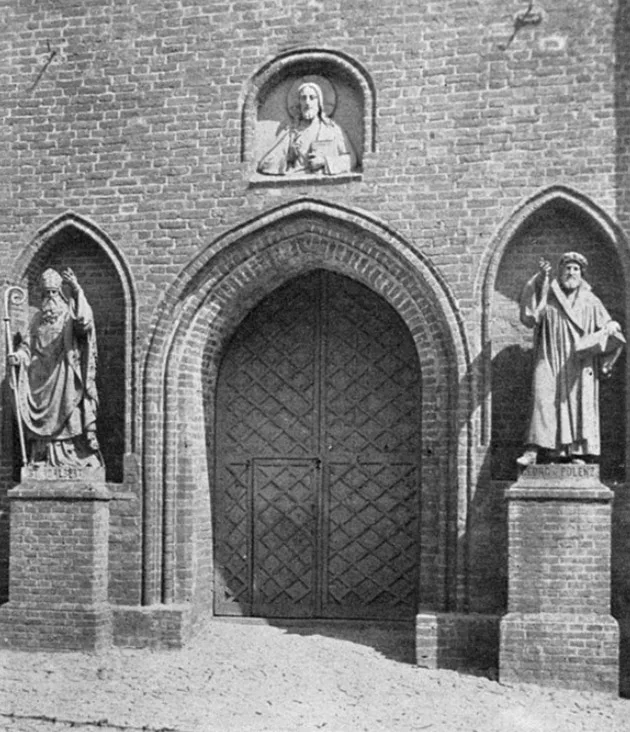
The portal of the Fischhausen church
with figures of Saint Adalbert and Bishop Polenz. 1864
In the evenings he attended an art school. After receiving several awards for his success in drawing, Rudolf was able to enter the Königsberg Academy of Arts. However, it did not yet have a sculpture class then, and he soon realized that he would have to move to Berlin.
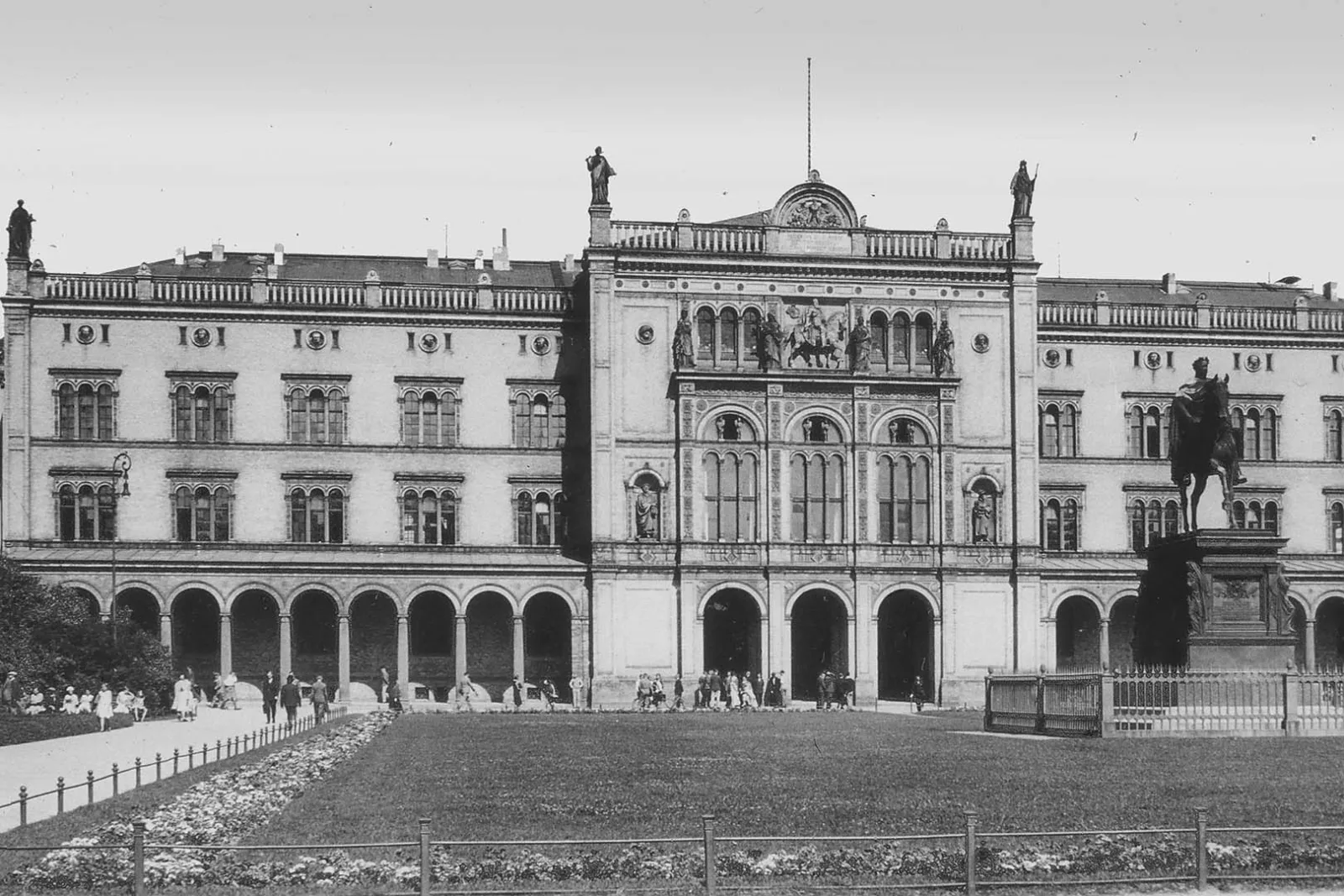
The facade of the new Albertina was decorated with portrait medallions of local geniuses by Siemering.
He tried to earn the money needed for the move by making portrait busts, and gradually managed to put together a small sum. Karl Voigt, pastor of the Sackheim church, who was friendly toward him, obtained for the talented young man a scholarship of 80 thalers for several years from the Gustav Adolf Society (Gustav-Adolf-Stiftung), which allowed Rudolf to leave his parental home in 1858.
In Berlin he was fortunate to find a place in the studio of Gustav Blaeser, a skilled representative of Rauch's school. Soon he began working as an assistant for a modest weekly wage, helping to create large monumental sculptures, such as the equestrian statue of King Frederick William IV for the Rhine bridge in Cologne and the relief on the gate of the railway bridge in Dirschau spanning the Vistula.
As early as 1861 Siemering opened his own studio in Berlin. There he created his early works for his "little homeland": ten graceful and expressive portrait reliefs for the facade of the new building of the University of Königsberg (1860), and a bust-length high relief of Christ and figures of Saint Adalbert and Bishop Poelenz for the Fischhausen church (1864).
In 1862 the young artist drew the public's attention by entering the competition for a monument to Schiller, where he won second prize. The work was not realized, but his name became known far beyond Berlin.
The prize made it possible that same year to travel to Paris and then to Italy, where he continued to perfect his craft, drawing inspiration from the classics of antiquity and the masters of the Renaissance. Although Siemering's financial situation after his return was far from brilliant, the young sculptor's name had become so well known that he soon received a number of prestigious commissions. First, from the Privy Commercial Councillor Alexander Mendelssohn, came a commission for a marble figure of King William I for the Berlin Stock Exchange, executed from a sketch by Hitzig (1866), and soon afterwards the Academy of Sciences in Budapest commissioned from him a statue of the philosopher Leibniz. There were also private commissions.
Despite all this, real success was still far off, as he wrote to his fiancée Martha, the second daughter of Councillor Brausewetter, in Potsdam; he had become engaged to her at New Year, and he carved her bust in marble (1867).
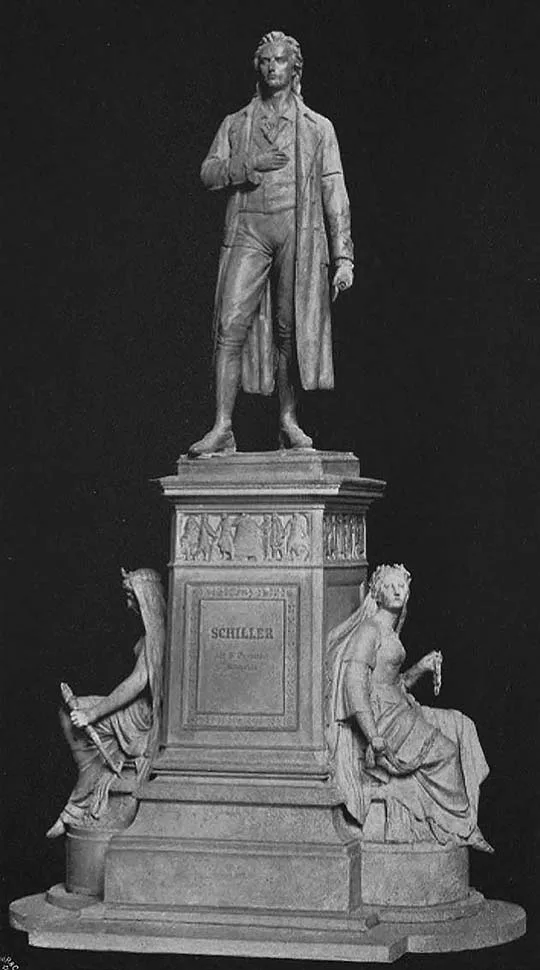
Competition model of the Schiller monument. 1862
Then the Franco-Prussian War broke out, paralyzing all artistic life, yet marking the beginning of a new, brilliant chapter in his work.
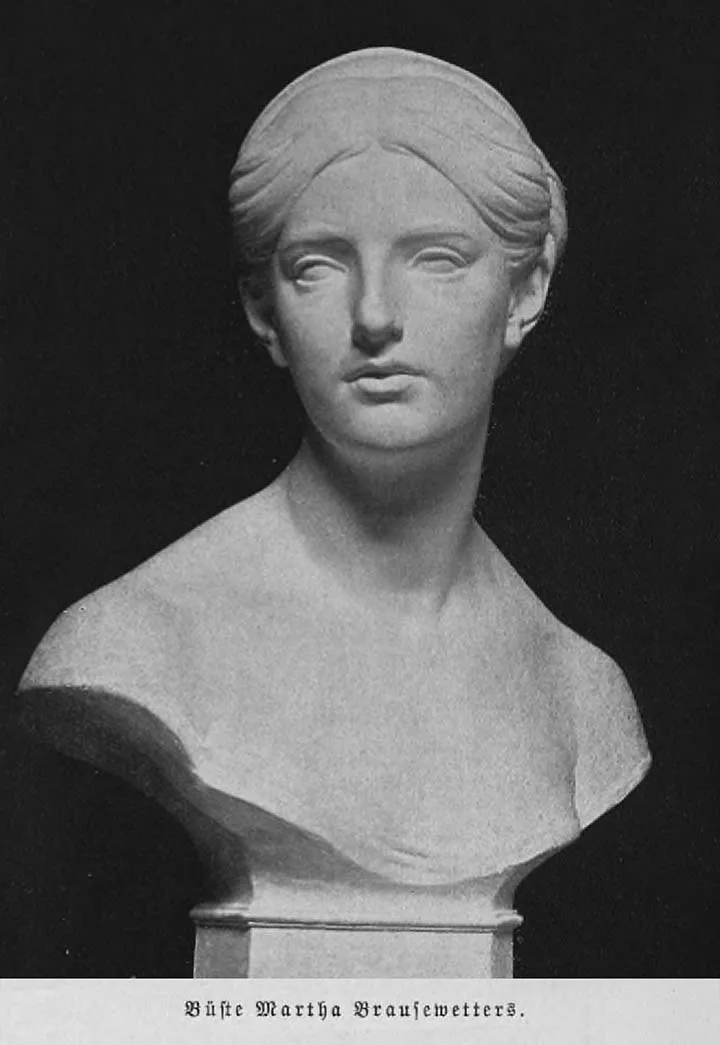
Marble bust of Martha Brausewetter. 1867
In July 1870 Siemering wrote to his fiancée: "For a long time no nation has been as shaken as the German nation is now. Everyone has stopped working; everyone thinks only of death." "Work does not hold me back all that much; rather it is the thought that it would now be more fitting to go to the front or join the Order of Hospitallers…" "Lucrative state commissions go to the senior professors; I am paid for reliefs on coins…" Fortunately, he was exempted from military service.
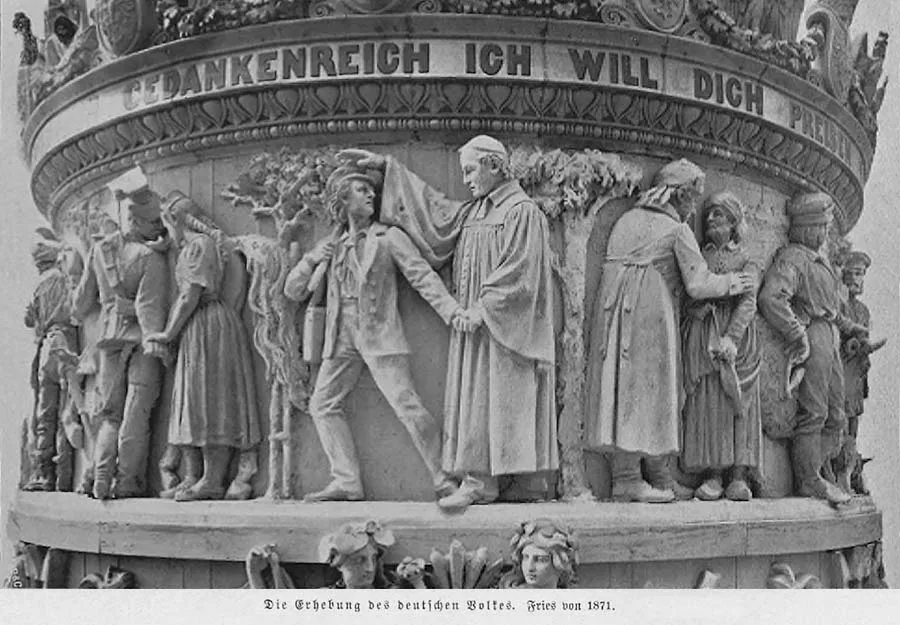
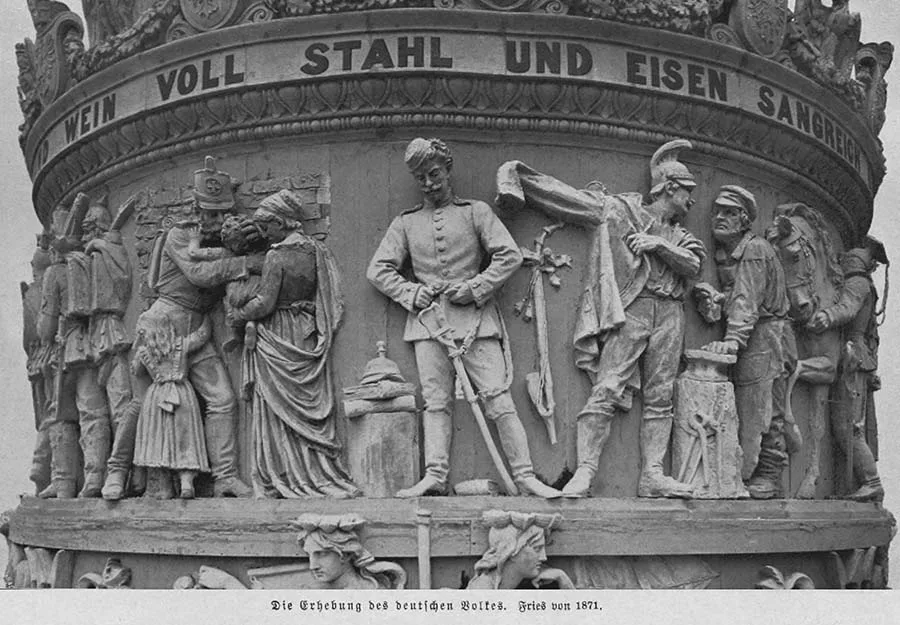
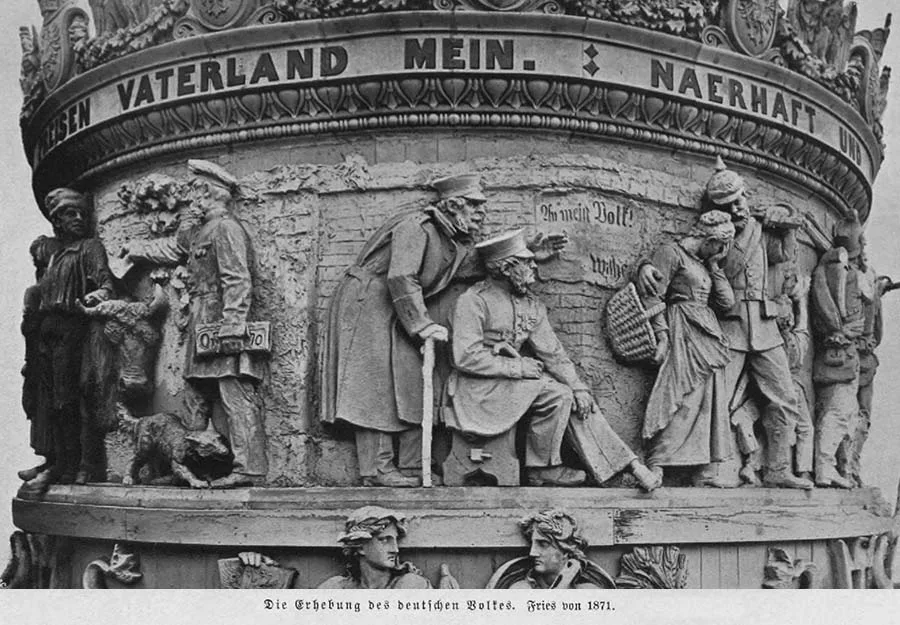
When the King and Bismarck returned to Berlin in May 1871, preparations began for receiving the victorious army. Siemering received a commission for a grandiose 80-foot relief for the Victory monument, which was to be erected in the Lustgarten by 16 June. "Imagine my surprise, and later my fear: 35 figures, each eight feet high, in 14 days. That is no small feat…" On 12 June he continued: "Imagine the gigantic relief I wrote about, devised on the first day, drawn on the second and finished today. I hired nine young men (all of them worked like lions), ordered five large panels, each six feet high and six feet wide, distributed them between my studio upstairs and Hagen's studio downstairs, and then divided the assistants into pairs and instructed each pair to carry out a fragment of my sketch on their panel.
The din that filled the studio resembled non-stop gunfire on a battlefield!
Of course, I had to spend the whole day going from one group to another, correcting one man's leg or another's arm, which seemed too limp, then enlivening the heads and giving them expression, and so on. The theme was Germany's military might. In the centre I placed a herald with the imperial flag, calling to battle. From both sides soldiers rush toward him: Bavarians beside Saxons, Württembergers arm in arm with Prussians... Then come scenes of farewell: at the gate I placed invalids, and also a student who has just received his equipment, then a journeyman blacksmith with his fine master, who is upset that the lad gladly puts on a soldier's uniform; then a rural scene in which a young farmer receives his summons to report (a call-up order) and his old mother is comforted by his father, and so on and so on; all in different national costumes, to show how the whole people rise as one to defend Germany."
When the troops entered the capital, the streets of Berlin were adorned with magnificent decorations. Architects, painters and sculptors joined forces and, despite the feverish haste, the artistic design created an effect the like of which Prussia had never seen.
The temporary monument “Germania”, erected in Berlin in front of the City Palace in 1871 for the celebrations of the victory and the return of the troops.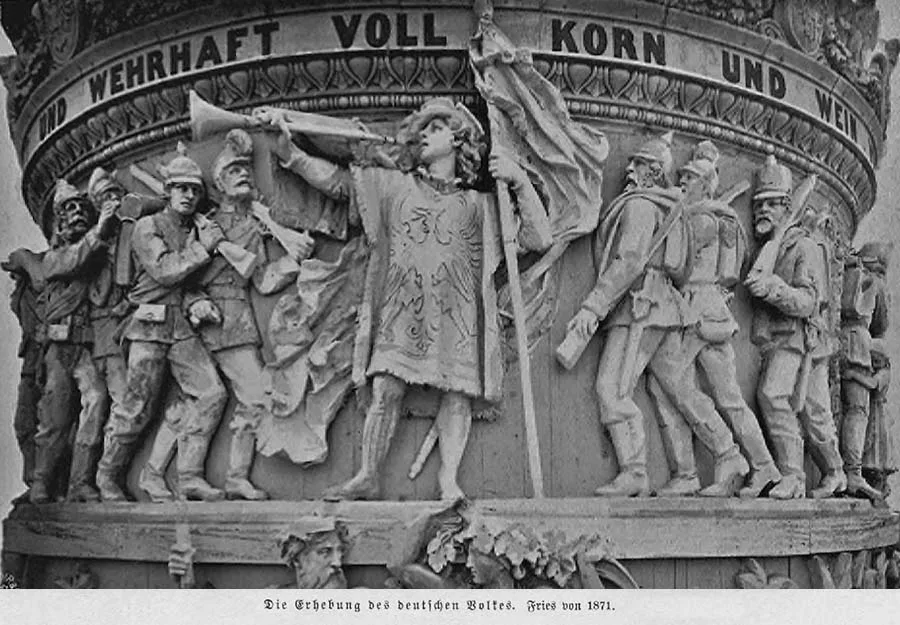
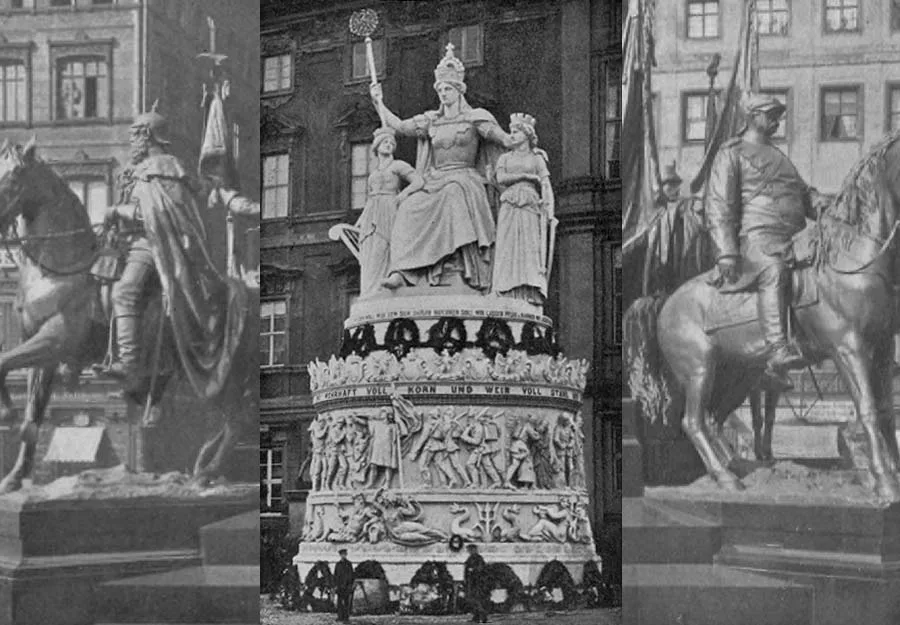
At the end of the Victory Avenue, on the main parade ground of the Lustgarten in front of the palace, a six-metre statue of Germany enthroned rose on a high pedestal, embracing her newly regained children: Alsace and Lorraine.
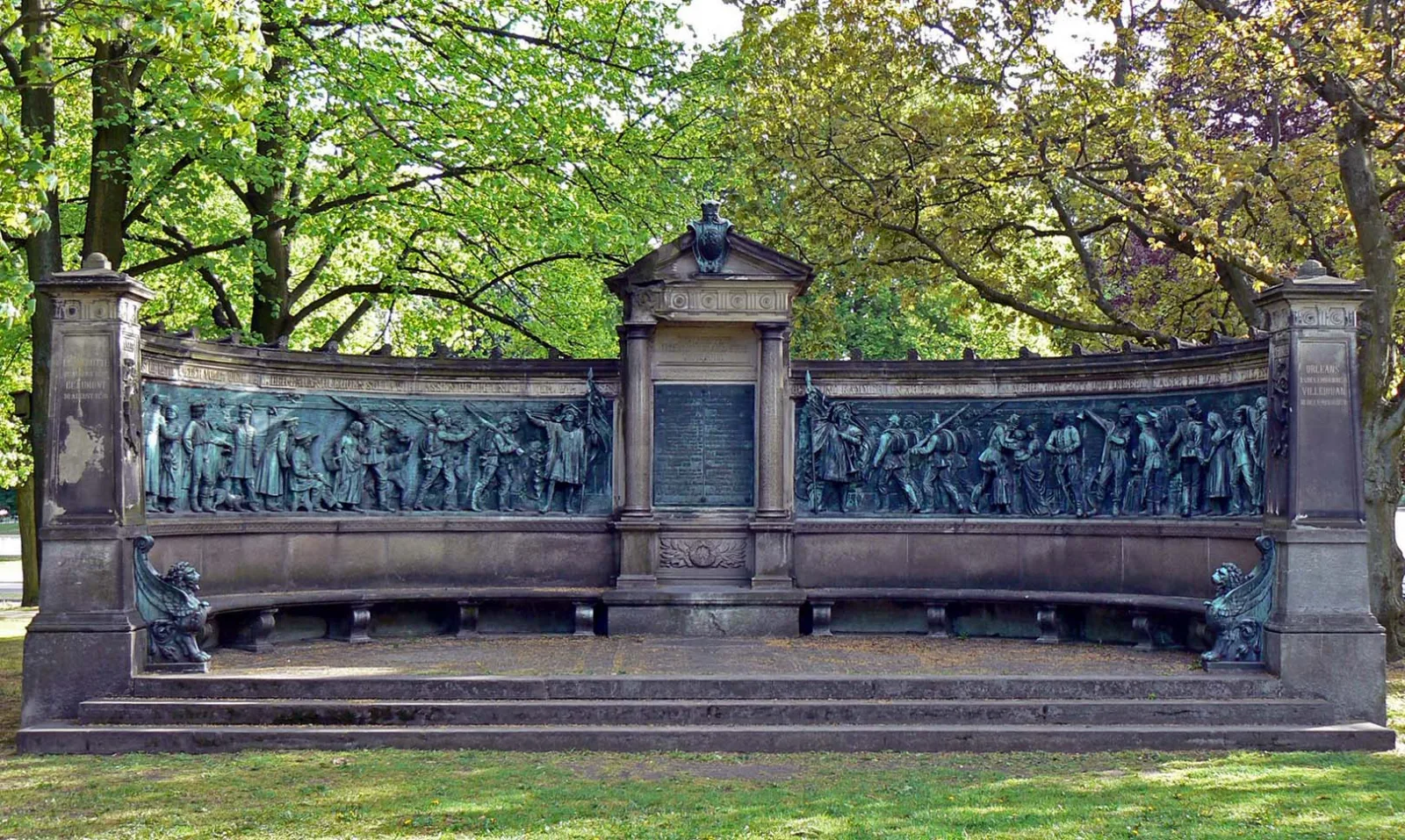
Memorial to the fallen of the Franco-Prussian War in the Schlossgarten palace park in Kiel. 1879
The model, created by Albert Wolff from a sketch by Martin Gropius, was executed by Albert Dankberg. The lower part of the tall cylindrical pedestal was surrounded by allegorical figures of Germany's main rivers, separated by groups of dolphins. This high relief was executed by Emil Wahlsleben. The broad part of the pedestal was occupied by a frieze almost 19 metres long of life-size figures depicting the gathering of the troops, created by Rudolf Siemering.
If his image of Schiller, created on the eve of the war, merely drew the public's attention to the young artist, this frieze made him the most popular sculptor in Berlin.
The frieze unexpectedly made a strong impression on almost everyone who saw it. The composition of familiar figures, rendered in an unpretentious manner, was received with enthusiasm by all strata of society, and it became obvious to the authorities that the work created for the celebration had to be preserved.
A buyer for the original frieze was found in the person of the Privy Commercial Councillor Warschauer, who set it up in the garden of his department store in Charlottenburg.
Later, reduced versions in terracotta were commissioned for Görlitz (1873) and Kiel (1879), but they do not create the grandiose impression that the original made. In the same spirit as the frieze, the bronze reliefs "Departure" and "Return" for the Aue Gate (Auetor or Au-Tor) in Kassel were created between 1873 and 1877.
In the autumn of 1871 Siemering was able to move into a new studio and accepted an offer to head the Rauch Museum (Rauch-Museum).
Commissions came in from various towns. In 1872, when West Prussia was marking the 100th anniversary of its union with Prussia, three well-known Berlin sculptors, Siemering, Süssmann-Hellborn and Wilhelm Wolff, were invited to submit competition sketches for a monument to Frederick the Great in Marienburg, the former residence of the Teutonic Order. The statue of the king was commissioned full-length. On the sides of the pedestal there were to be figures representing the four most outstanding Grand Masters of the Order: Hermann von Salza, Siegfried von Feuchtwangen, Winrich von Kniprode and Margrave Albrecht of Brandenburg. The great king was to be immortalized in the symbolic company of his predecessors.
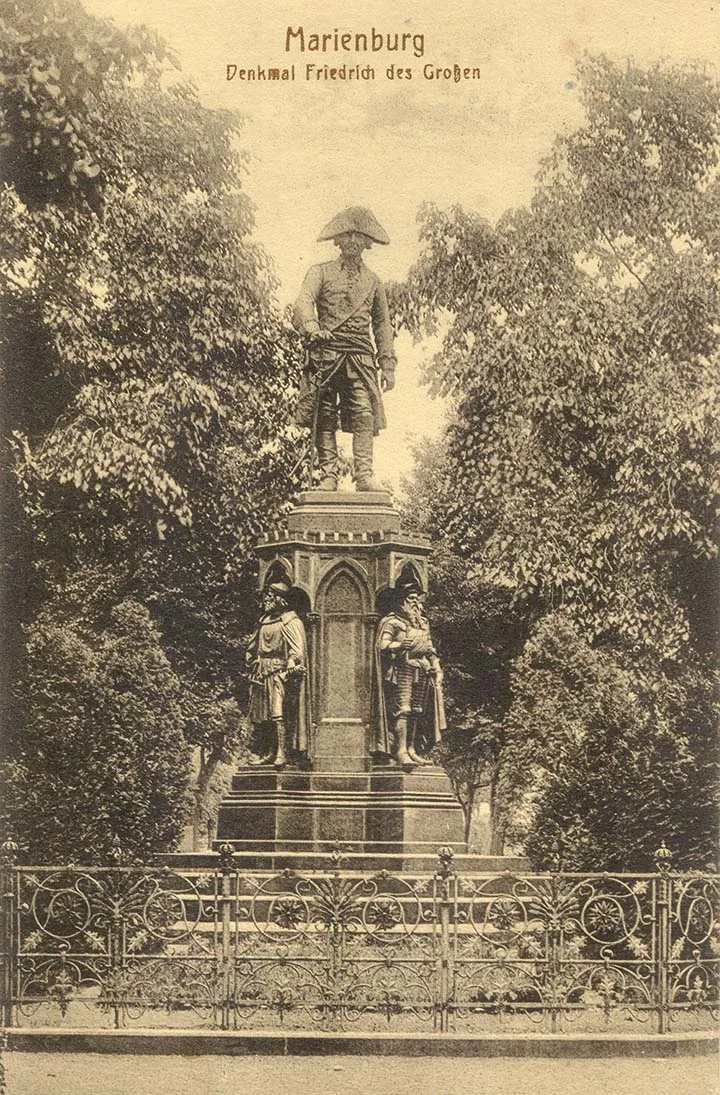
Monument to Frederick the Great in Marienburg. 1877
Siemering designed the pedestal in Gothic architectural forms and managed to create vivid and original figures of the Grand Masters, despite the absence of engraved portraits. He won the competition.
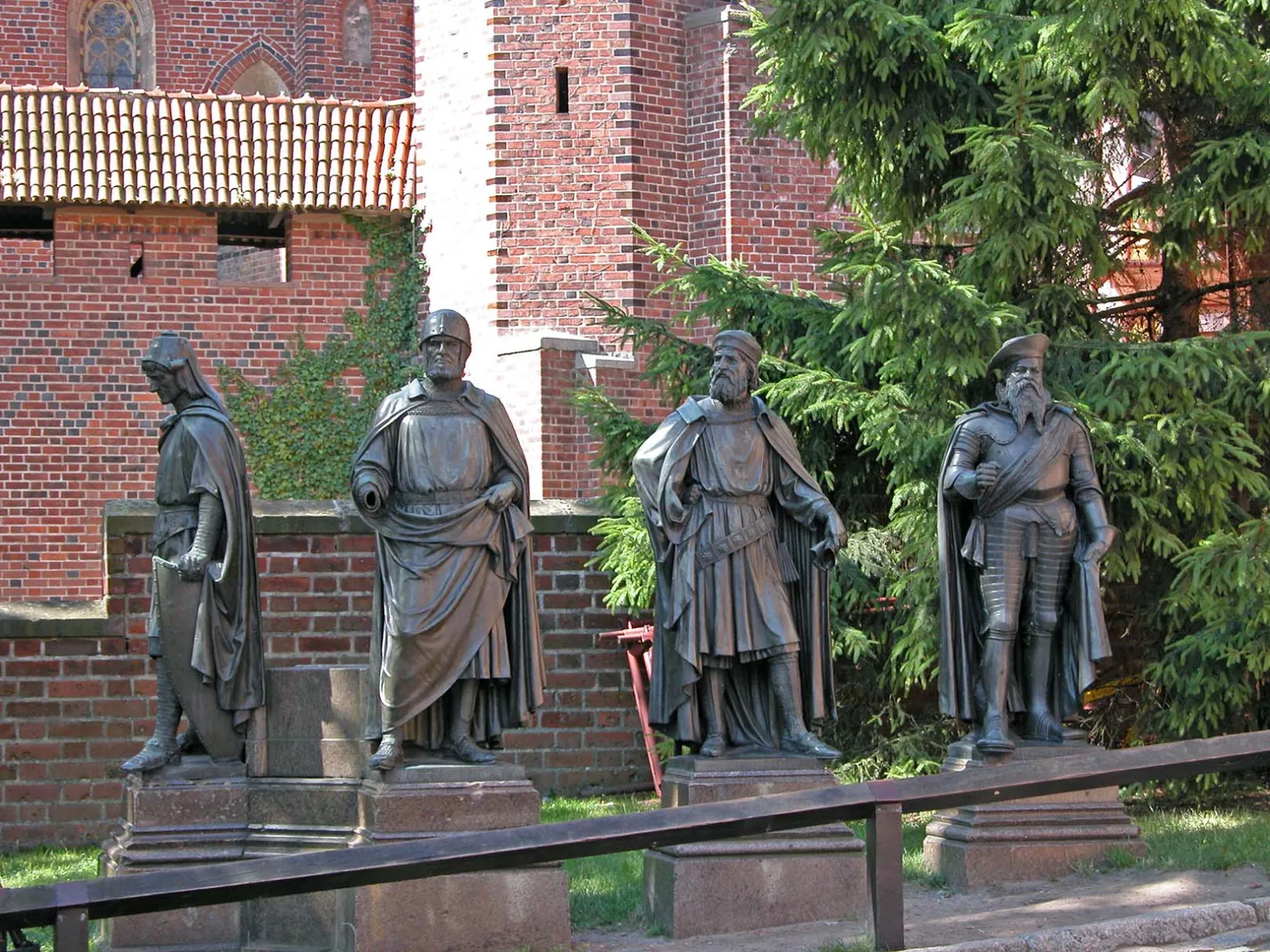
Figures of the Grand Masters in the courtyard of Malbork Castle.
The monument was cast in Gladenbeck's foundry and unveiled in 1877. After 1945 it was dismantled and the main sculpture of Frederick was melted down, but the four Grand Masters can still be seen today in the castle courtyard.
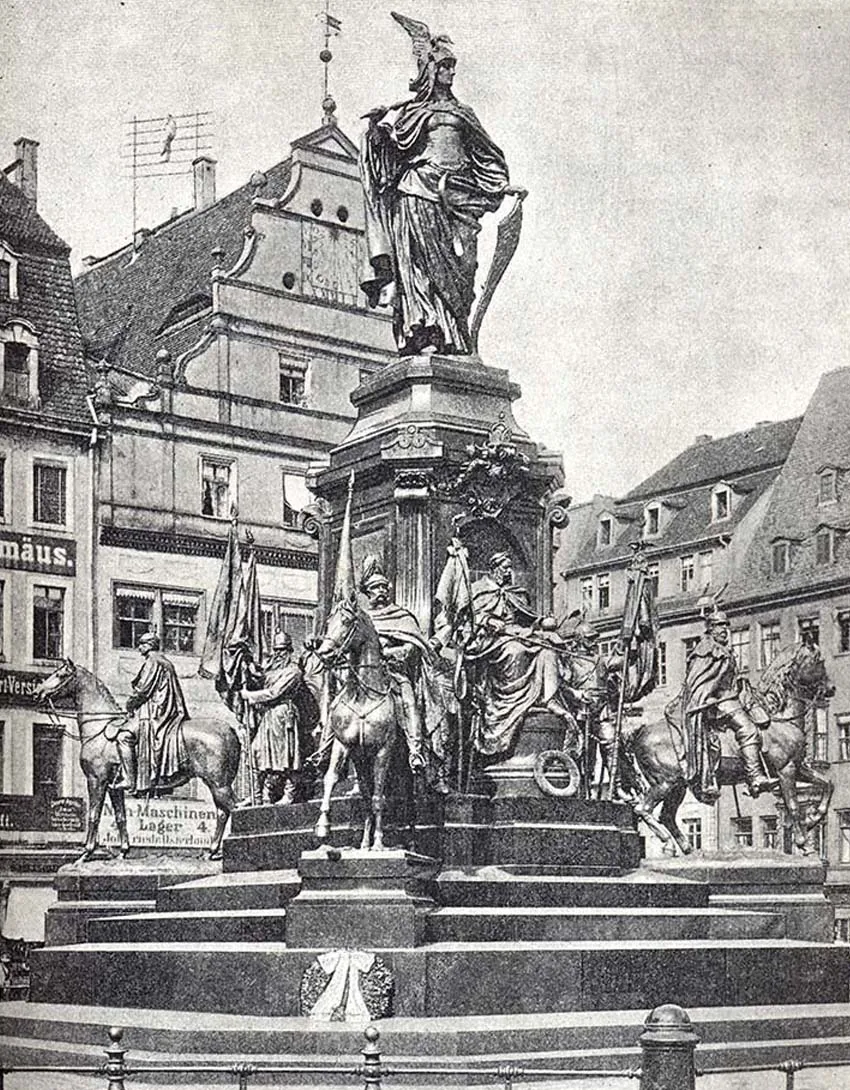
In September 1872 Rudolf Siemering married Martha Brausewetter. The first years of the marriage were overshadowed by bouts of illness that confined him to bed for months at a time. Only in the spring of 1876 did he regain his former energy and creative strength. But during this critical time he created the sketches for the reliefs of the Aue Gate in Kassel and for the Victory monument in Leipzig, which won the competition of 1874.
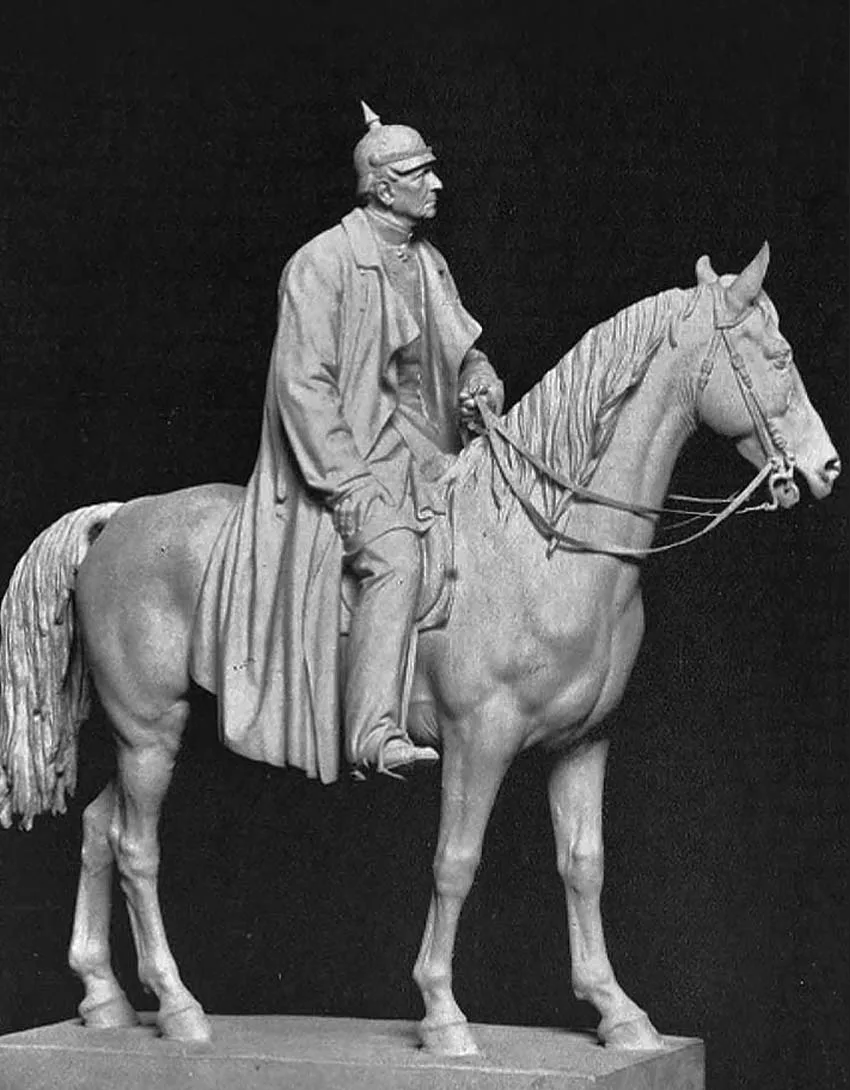
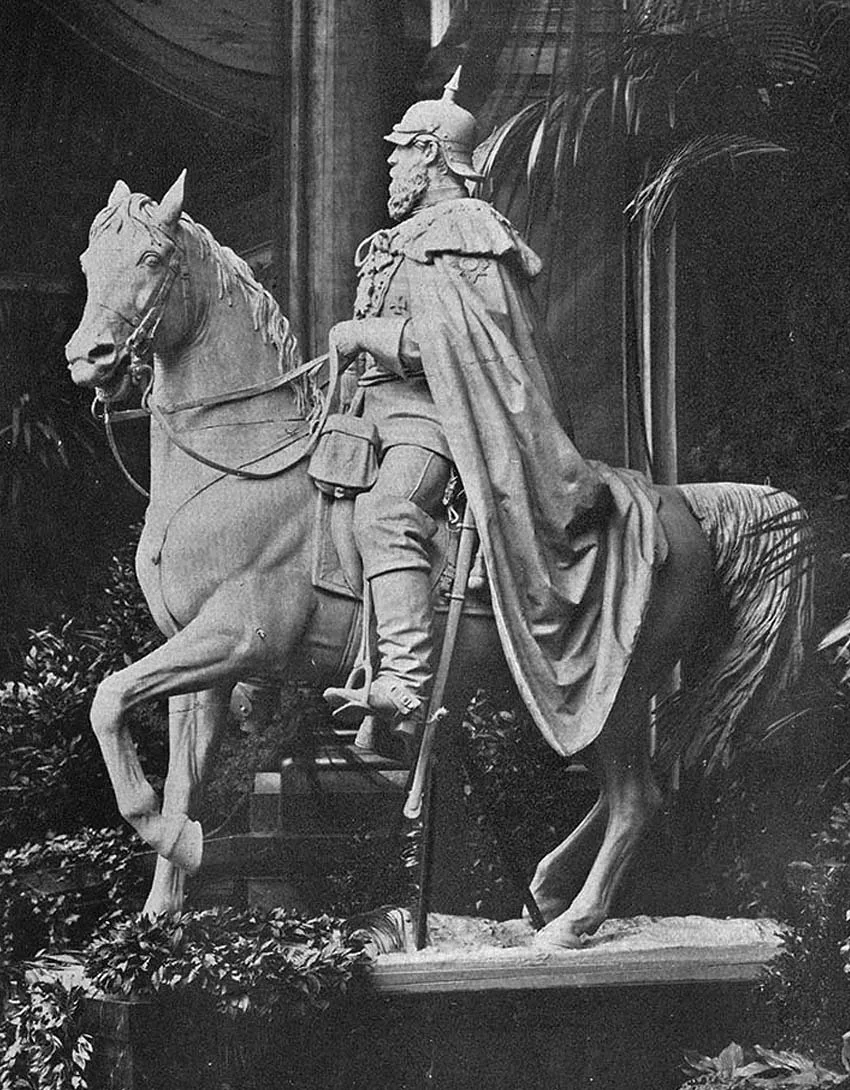
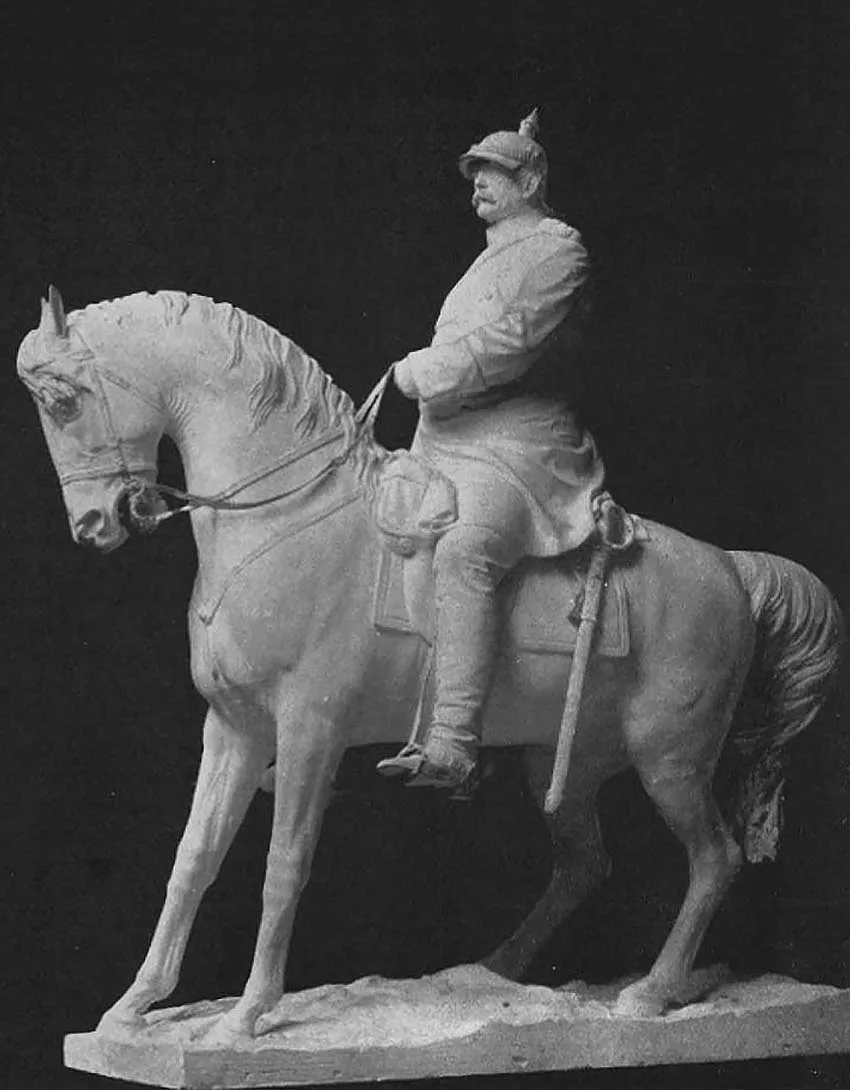
On a high pedestal stands an allegory of Germany, clad in armour and a cloak draped in the Baroque manner. At the base of the pedestal is a mighty stylobate of three steps; at the corners are standard-bearers of all branches of the army and equestrian figures of the crown princes Albert of Saxony and Frederick of Prussia, of Bismarck and of Moltke; slightly higher, the Kaiser sits enthroned.
Each of the four equestrian figures standing at the corners of the pedestal was in itself a magnificent monument. The images of the horses demonstrate the master's supreme level of skill: all of them are distinguished by individuality, realism and precision of detail.
It is worth noting how carefully Siemering prepared his models of horses and with what anatomical knowledge he modelled every muscle. He strove for the greatest possible accuracy in creating a sort of portrait of a particular horse, while at the same time creating an ideal image. And he always knew how to emphasize the character of the rider through the behaviour of the horse. For example, Moltke's calm, slender Arabian horse sensitively flares its nostrils, while Bismarck's sturdy, fiery stallion shows temper and is hard to control. Besides the effectiveness of the sculptural pose, Siemering understood how to unite horse and rider organically into a single whole and to convey character in this interaction.
After many difficulties, the monument was solemnly unveiled on 18 August 1888 in the presence of the King of Saxony.
In 1876 Siemering took part in the competition (and won it!) for a monument to Luther in Eisleben, Luther's birthplace, on the occasion of the 400th anniversary of the reformer's birth. The monument, unveiled in 1883, still adorns the central square of Eisleben.
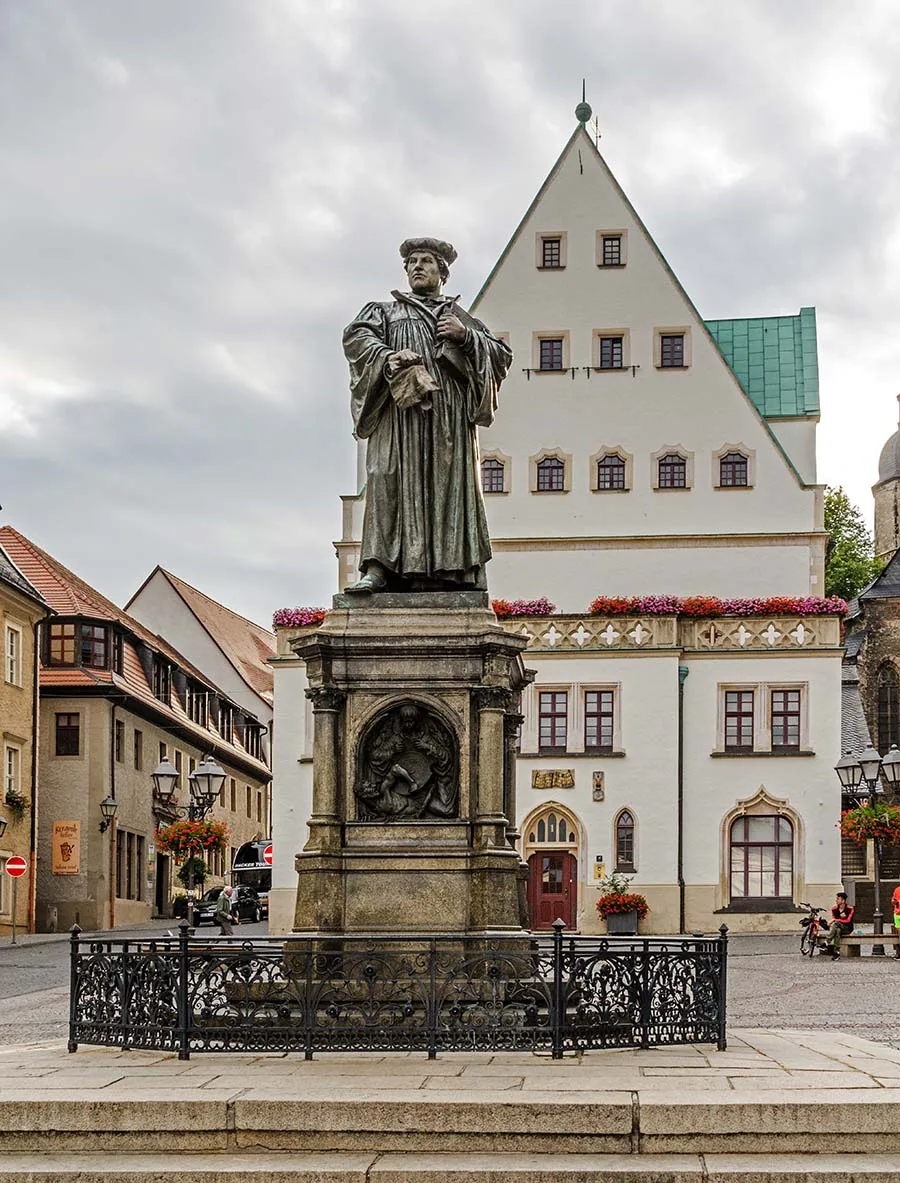
Monument to Martin Luther in the great reformer's hometown. 1883
Gripping in his right hand the crumpled papal bull of excommunication and about to throw it into the fire, while pressing a Bible firmly to his chest with his left, Luther stands full of energy, manfully resolved not to yield. This agitated pose expresses the protest and unshakable conviction of the great church reformer.
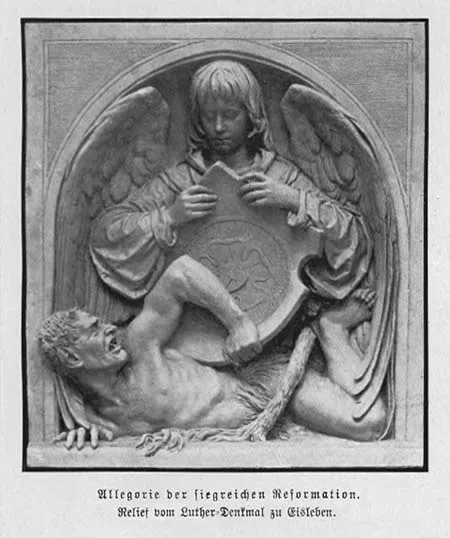
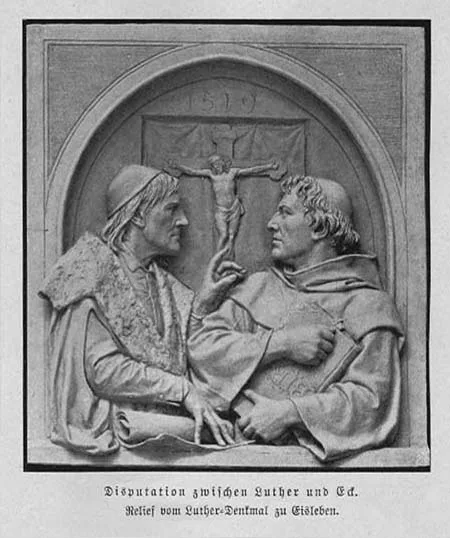
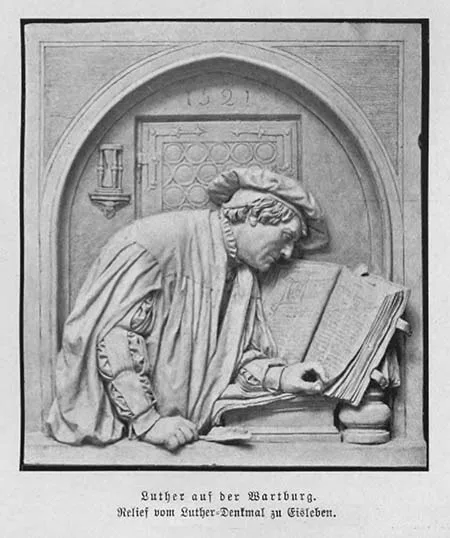
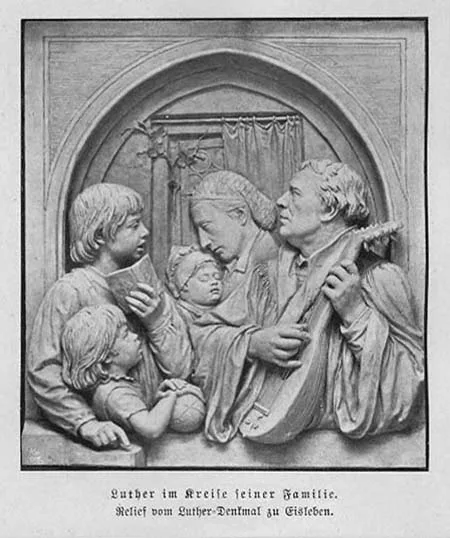
When the Lutherans of Danzig learned of the plan to erect the monument in Eisleben, they ordered a copy, and the sculpture was made in two examples, cast from one mould. The monument was solemnly unveiled near St. Mary's Church (now the Basilica of the Assumption of the Blessed Virgin Mary, Polish: Bazylika Konkatedralna Wniebowzięcia Najświętszej Maryi Panny w Gdańsku) on 10 November 1883, on the 400th anniversary of Luther's birth. Representatives of the municipal authorities, as well as teachers and pupils of Protestant schools, took part in the ceremony. The monument survived the events of 1945. However, the city's new inhabitants saw in it a symbol of German nationalism rather than of the Reformation, so it was dismantled and sent to be melted down.
In the spring of 1876 Siemering was entrusted, without a competition, with creating a monument to the ophthalmologist Albrecht von Graefe; an original and carefully thought-out work was expected of him. And these expectations were met. Near the garden of the Charité clinic rises the first monument to a man of science erected simply in a street in Berlin.
The compositional solution of the monument was unusual for its time. According to established practice, the figure would stand on a pedestal, and the garden behind it would serve as a background.
However, Siemering saw a flaw in this, since the bronze tone contrasted insufficiently with the dark green of the foliage, a problem that would not arise with a marble figure. Moreover, it is unfavourable to place a figure in realistically modern clothing on a pedestal. Understanding that Berliners could picture Graefe only in the everyday clothes in which everyone had seen him, but that a coat and trousers diminish the artistic effect of a free-standing figure, Siemering created an architectural frame, placing the sculpture in an exedra niche finished in dark green majolica and enlivening the side panels with coloured majolica friezes. The majolica reliefs on the right depict the sick who are still to be healed, and their companions; those on the left depict those already healed.
The polychrome finish of the friezes flanking the niche was an unexpected and bold innovation. Colour brings an impression of reality, and as a result the figures acquired a living warmth and emotionality. In addition, Siemering used tinting: the face and hands are lighter and have a more golden tone than the hair and clothing. This device gives the figure a considerably more realistic look. The choice of bronze and majolica was also dictated by practical considerations, since marble quickly begins to deteriorate in this climate. Bronze is durable, whereas there was no practical experience of using majolica in the open air, especially in winter conditions.
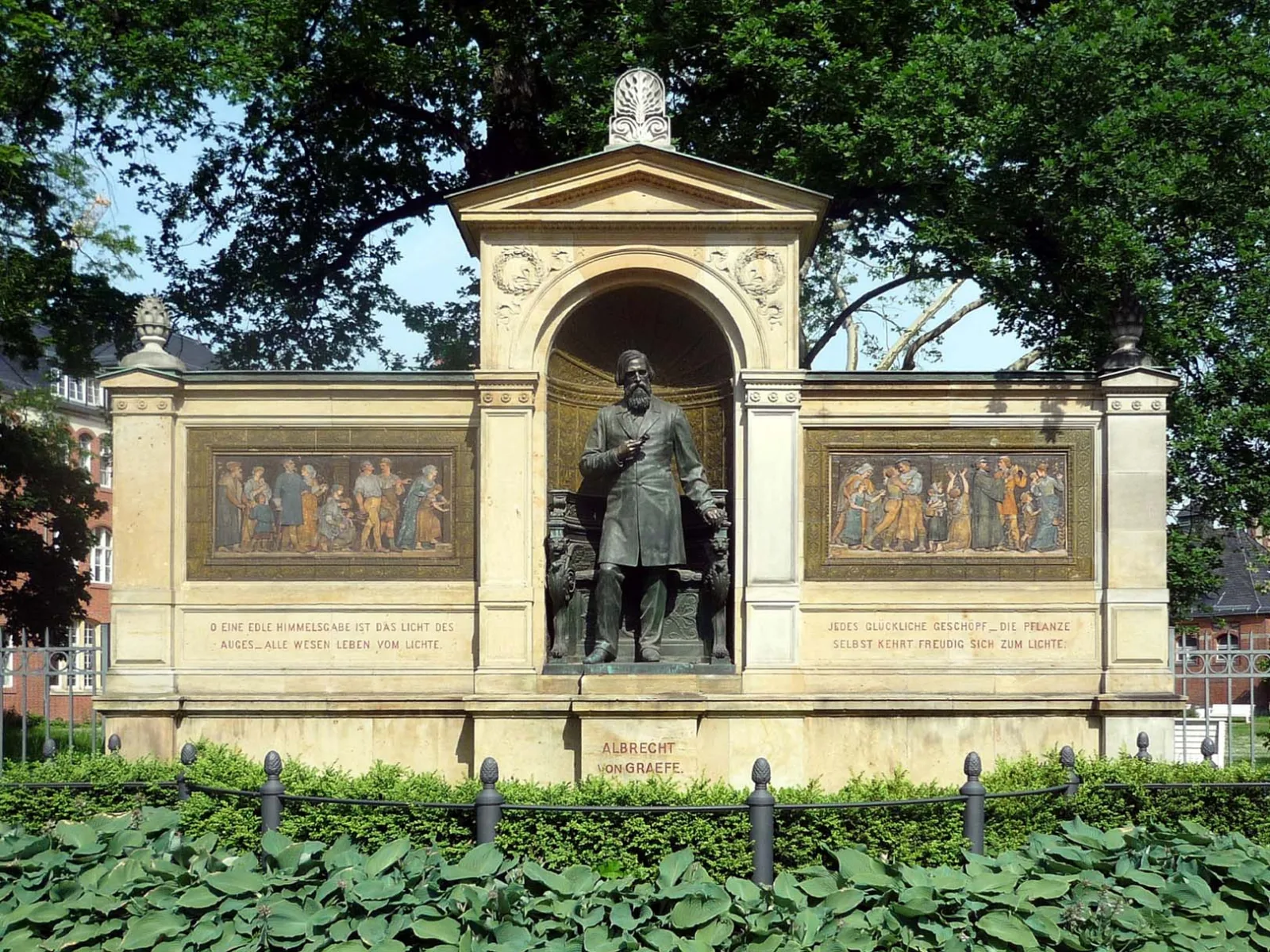
The Berlin monument to the ophthalmologist Albrecht von Graefe. 1882
For this reason Siemering carefully tested the strength of the majolica tiles, subjecting them to the boldest experiments: first he heated them until red-hot, then buried them in snow and left them in the open air for several weeks.
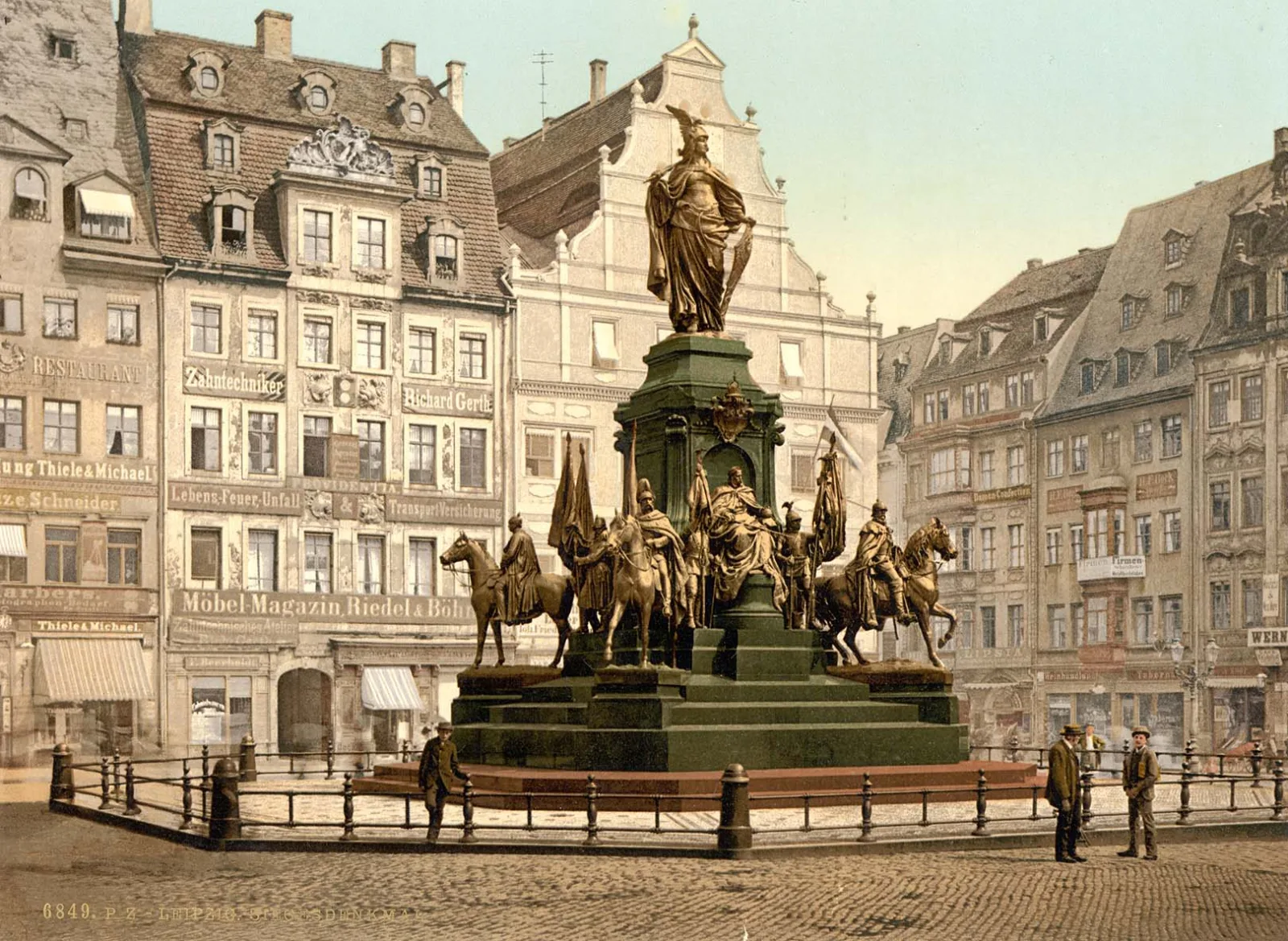
Victory Monument in Leipzig. 1888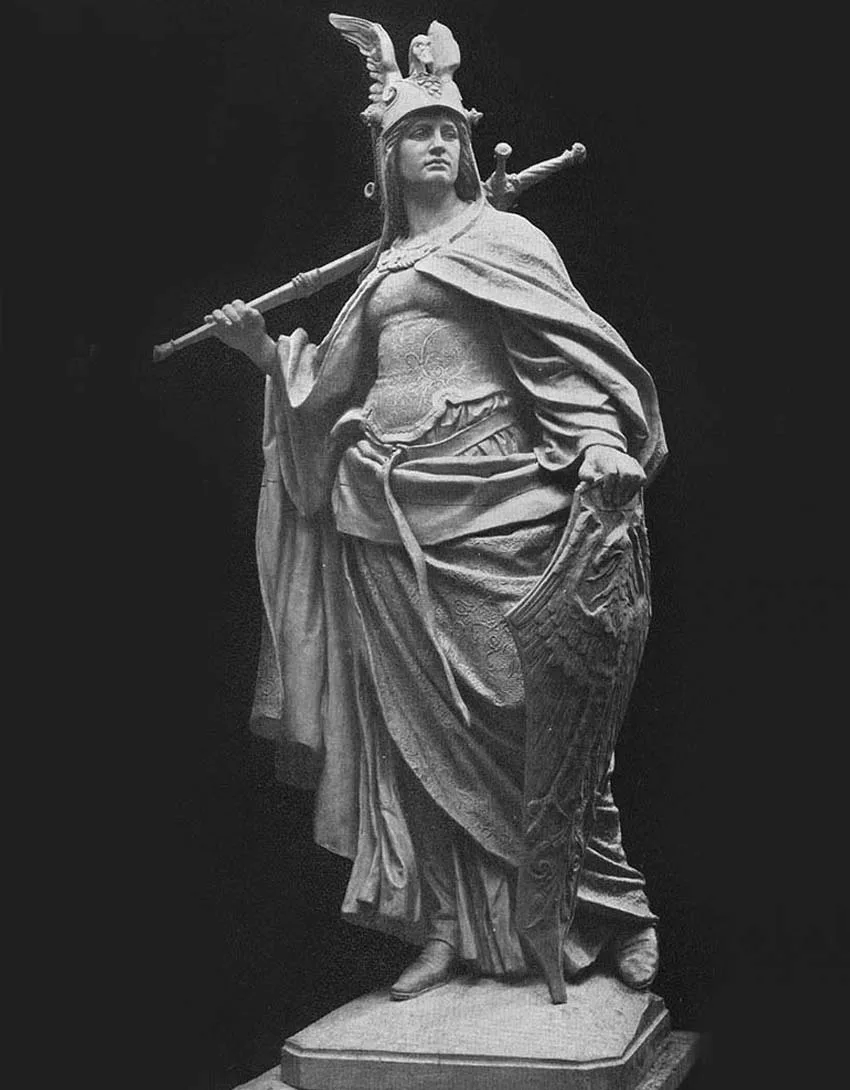
At the same time Siemering also took part in the construction of the Museum of Decorative Arts in Berlin. He modelled nine of the eighty-eight terracotta reliefs depicting craftsmen of various trades at work. Many of these figures are portraits of well-known people who took part in the construction. The model of the pediment field with the head of Athena was also created by Rudolf Siemering, and it was carved in sandstone by the sculptor Peter Kraemer.
While creating the models for the Leipzig Victory monument, Siemering was working on his largest project, a monument to George Washington for Philadelphia; in 1878 he was invited to a competition for it, which he won unreservedly. The contract was signed on 19 October 1881. In this project his most interesting solution was realized in terms of the artistic link between the rider and the accompanying figures.
The equestrian statue of General Washington, dressed in the military uniform of the period of the War of Independence, is raised on a pedestal decorated with allegorical and historical figures representing the United States of that time. A frontal figure of America with a trident and a cornucopia symbolizes prosperity.
The stepped platform leading to the pedestal represents the foundation: nature and the Native Americans. The four corner fountains symbolize the great local rivers; beside each is a pair of animals and a man with the attributes of hunting or fishing.
Parts of the monument were first exhibited at Berlin exhibitions, and all of it appeared at the exhibition of 1892, where this colossal work was fitted in only with enormous difficulty. Meanwhile, in the United States there were long disputes about the site for the monument. The solemn unveiling took place on 15 May 1897 in the presence of President William McKinley, who personally pulled the American flag off the equestrian statue.
The images of the animals earned the particular attention of the German Kaiser, and he expressed a wish to have such sculptures in Berlin. The foundry in Lauchhammer made copies from the original models; in 1900 they were installed in the Tiergarten on Flora Platz, surrounded by shrubbery, at the sides of the four main paths. The sculptures survived the cataclysms of the 20th century and to this day are a magnificent adornment of the park.
As early as March 1888, soon after the death of Emperor William I, a committee for perpetuating his memory assembled in Magdeburg. Initially it was intended to hold a closed competition for the design of an equestrian monument, but some committee members who had seen the Victory monument in Leipzig expressed a wish that its author create something equally inspiring for Magdeburg as well.
Monument to George Washington in Philadelphia.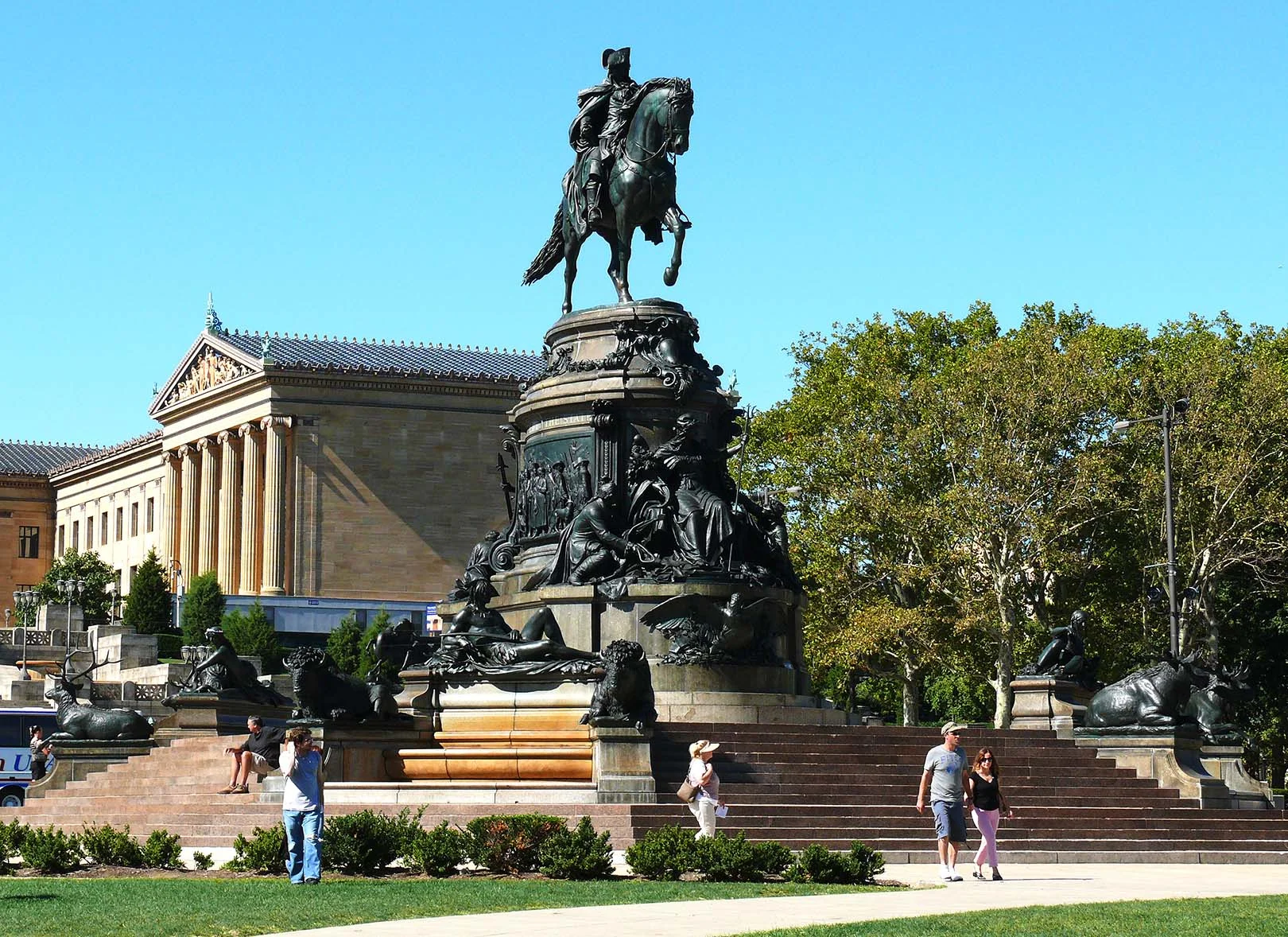
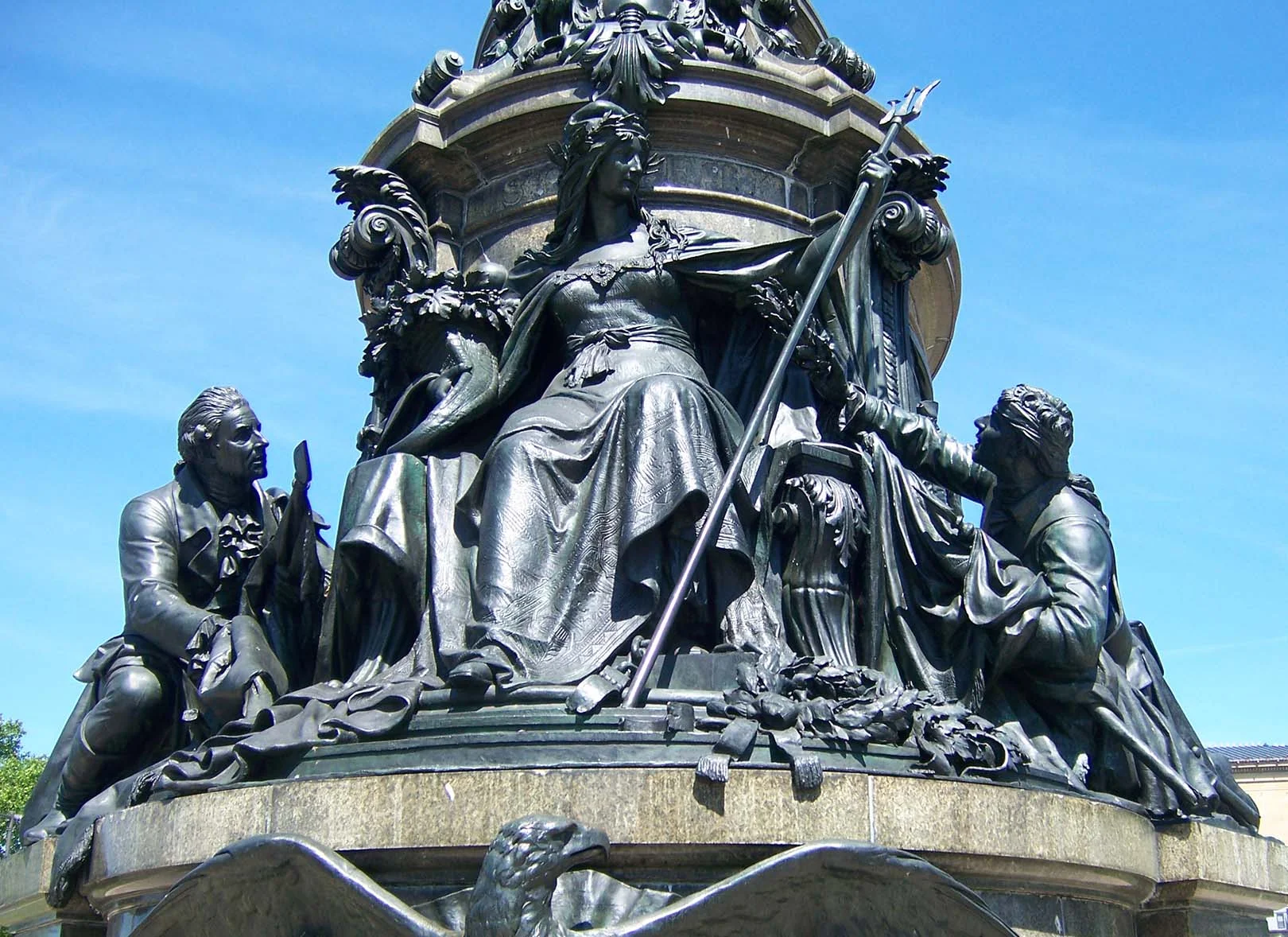
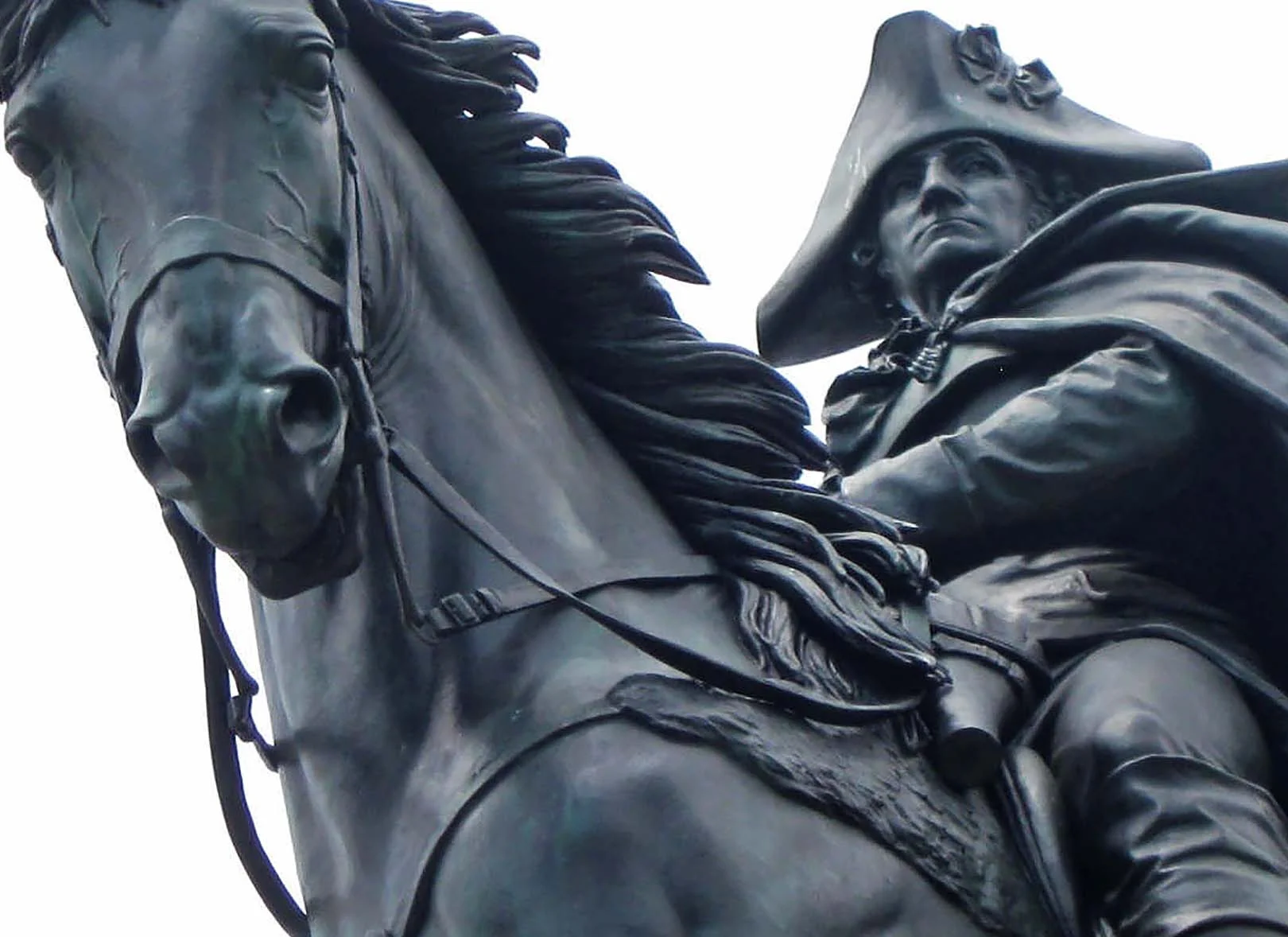
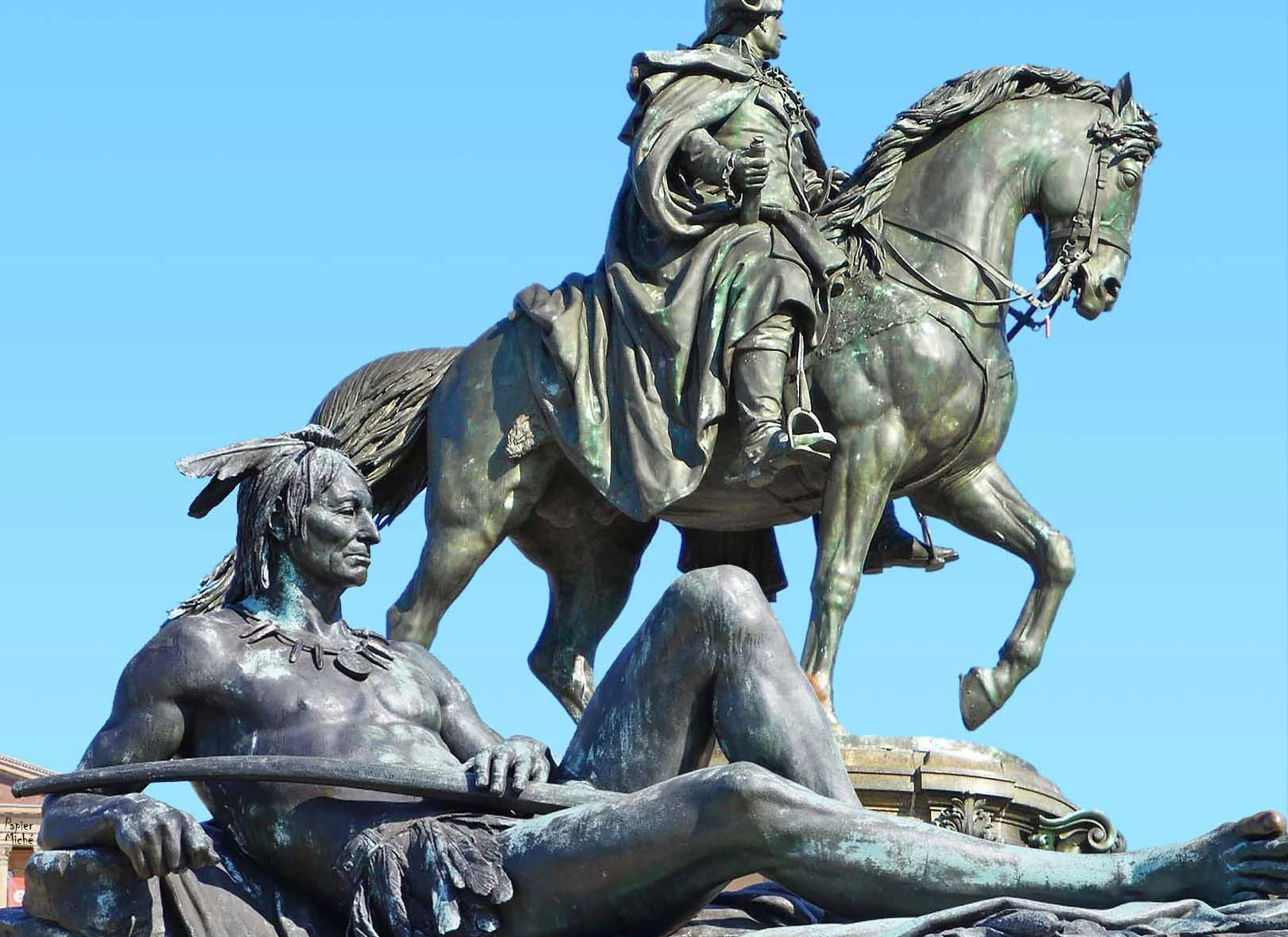
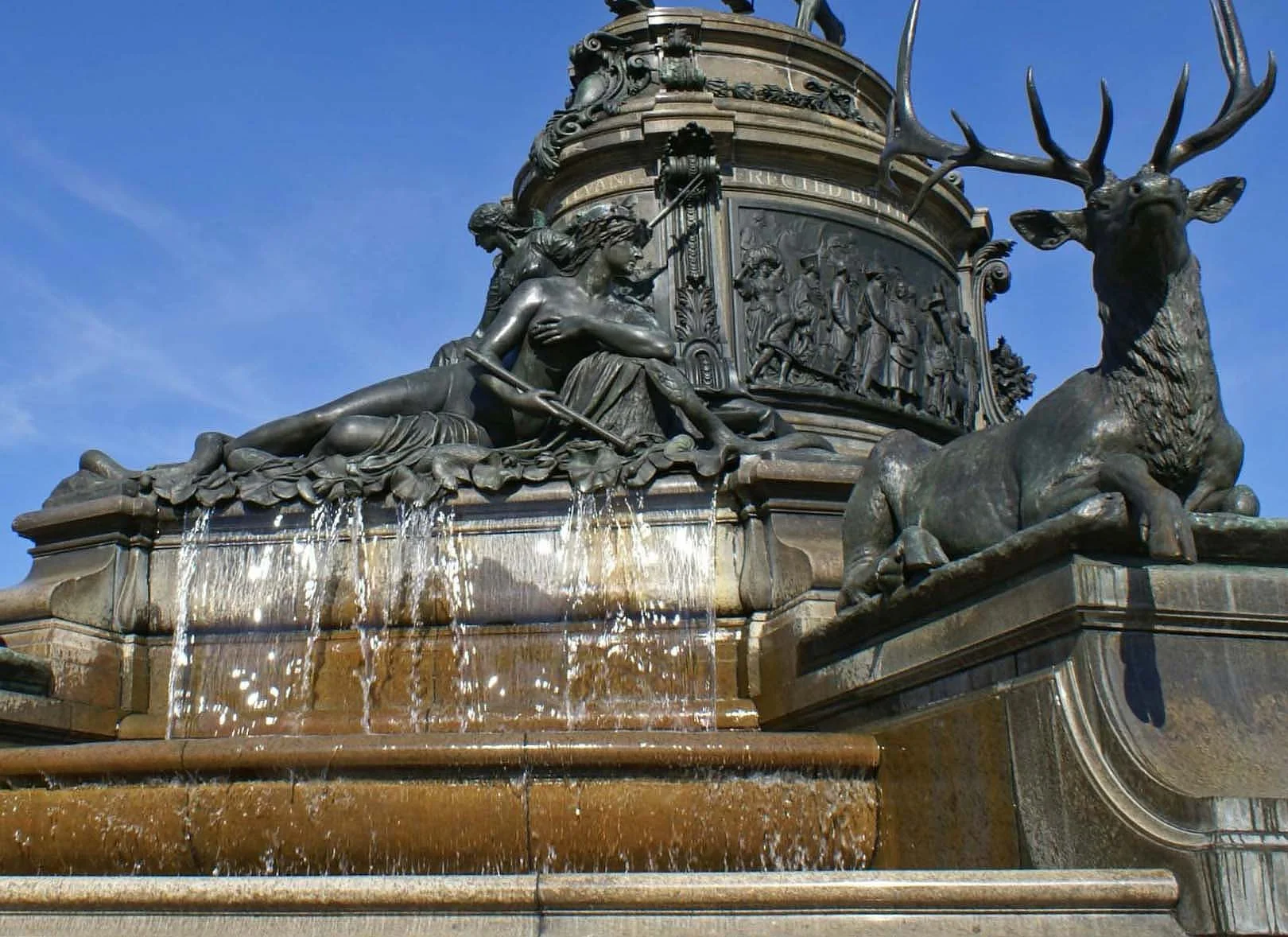
The image proposed by Siemering was free of pomp and was marked by the simplicity that was characteristic of William I.
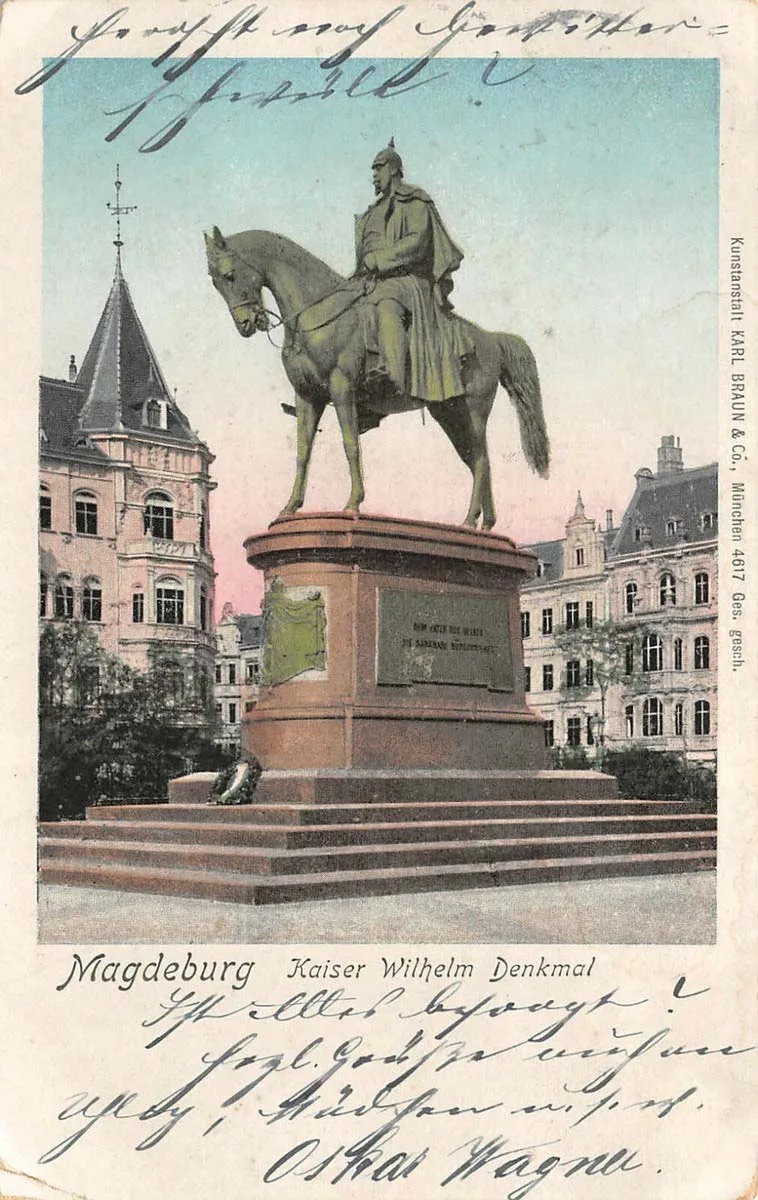
Monument to Wilhelm I in Magdeburg. 1897
The only decoration on the pedestal, made of Swedish reddish-brown granite, consists of the imperial eagle and crown on the front and the city's coat of arms on the back. Few equestrian statues unite horse and rider as organically as this one. The elegant, long-legged yet powerful horse is a portrait of William I's favourite mount. The Emperor is dressed in field uniform. Everything is plain, without a pompous pose, yet filled with calm dignity, which creates a sense of monumentality and grandeur.
New commissions came to Siemering in abundance, and only the habit of the routine of daily work made it possible to cope with them and to find new solutions.
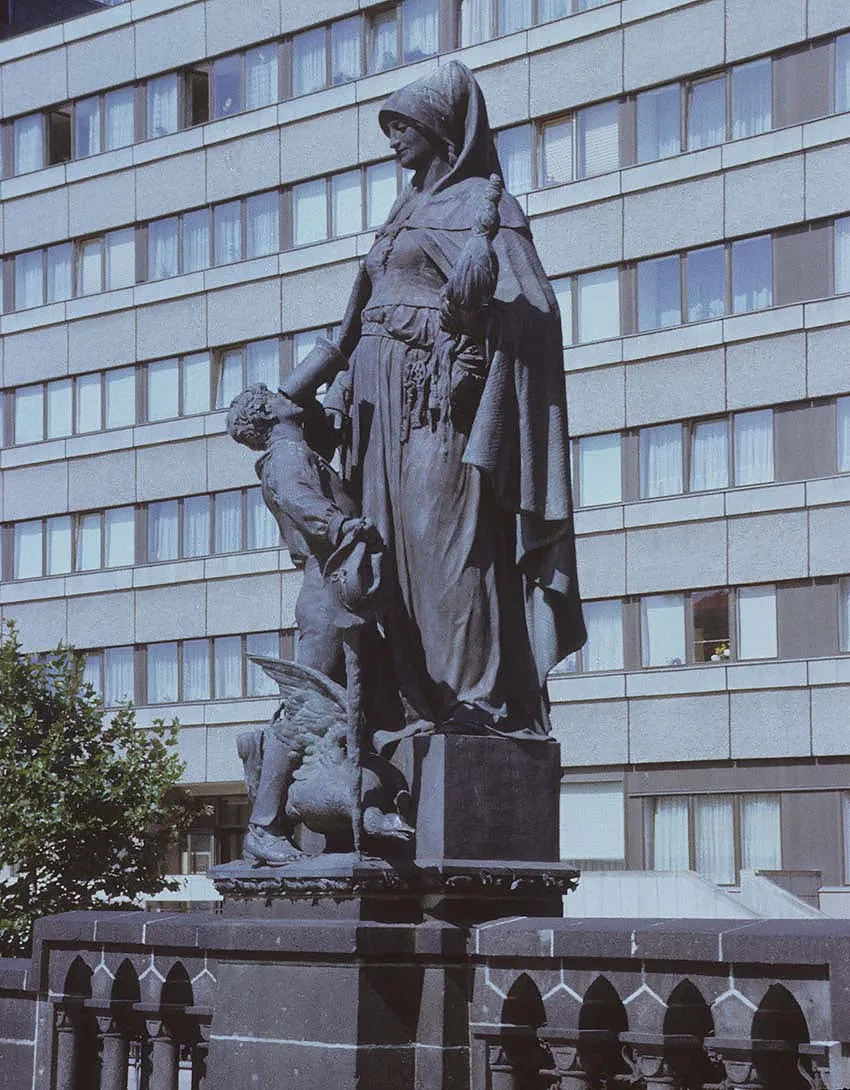
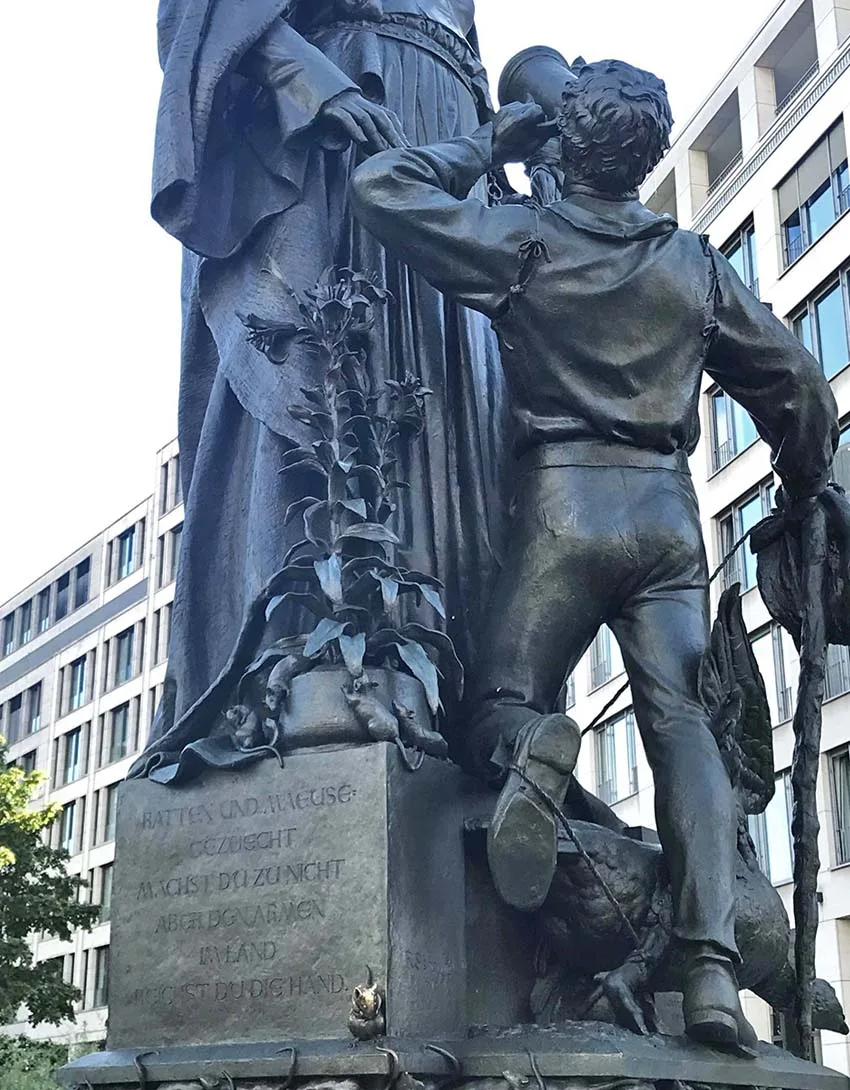
The Berlin municipality commissioned an image of Saint Gertrude, patroness of the new bridge (1896) next to the quarter where a hospital bearing her name once stood. Siemering had repeatedly reinterpreted historical subjects in a new style. And this time too the great sculptor of his age found a successful solution, combining a medieval theme with modern aesthetics and elements of folklore.
He used the attributes with which Saint Gertrude appears in early depictions: together with a staff she carries a lily, symbolizing virginity, and a spindle wound with yarn, symbolizing the cosy home she provided to the poor.
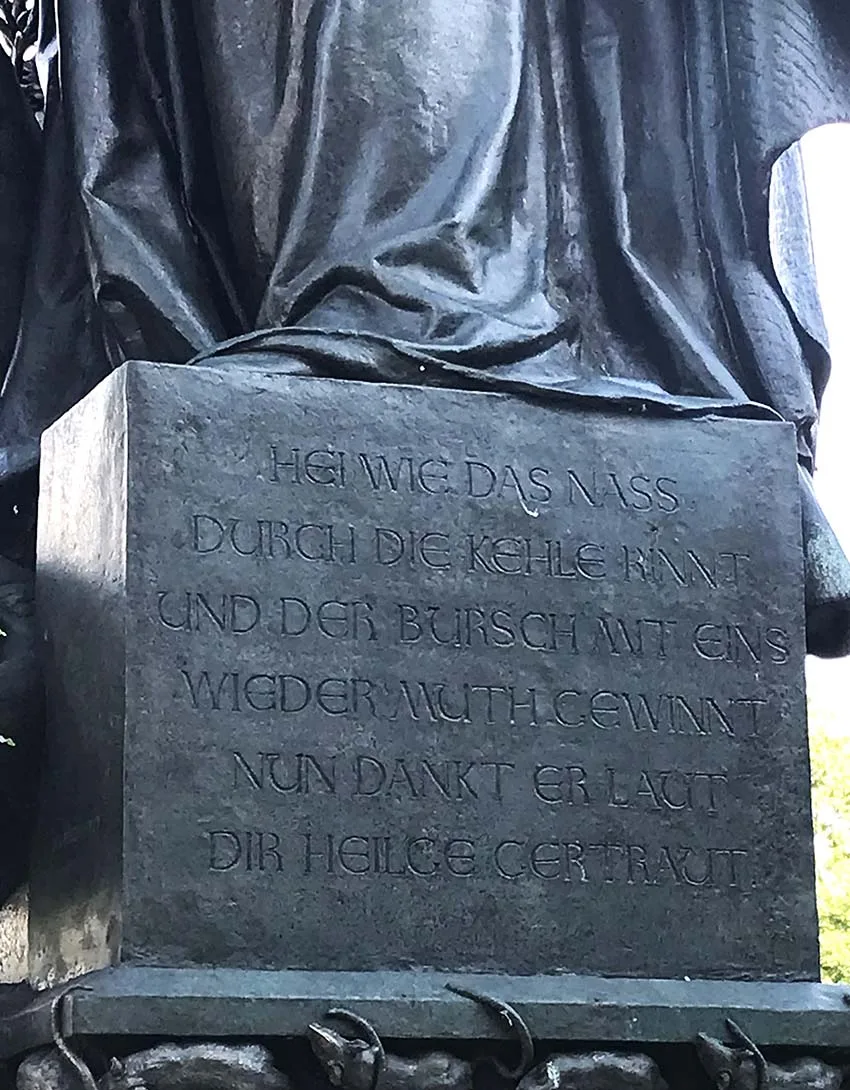
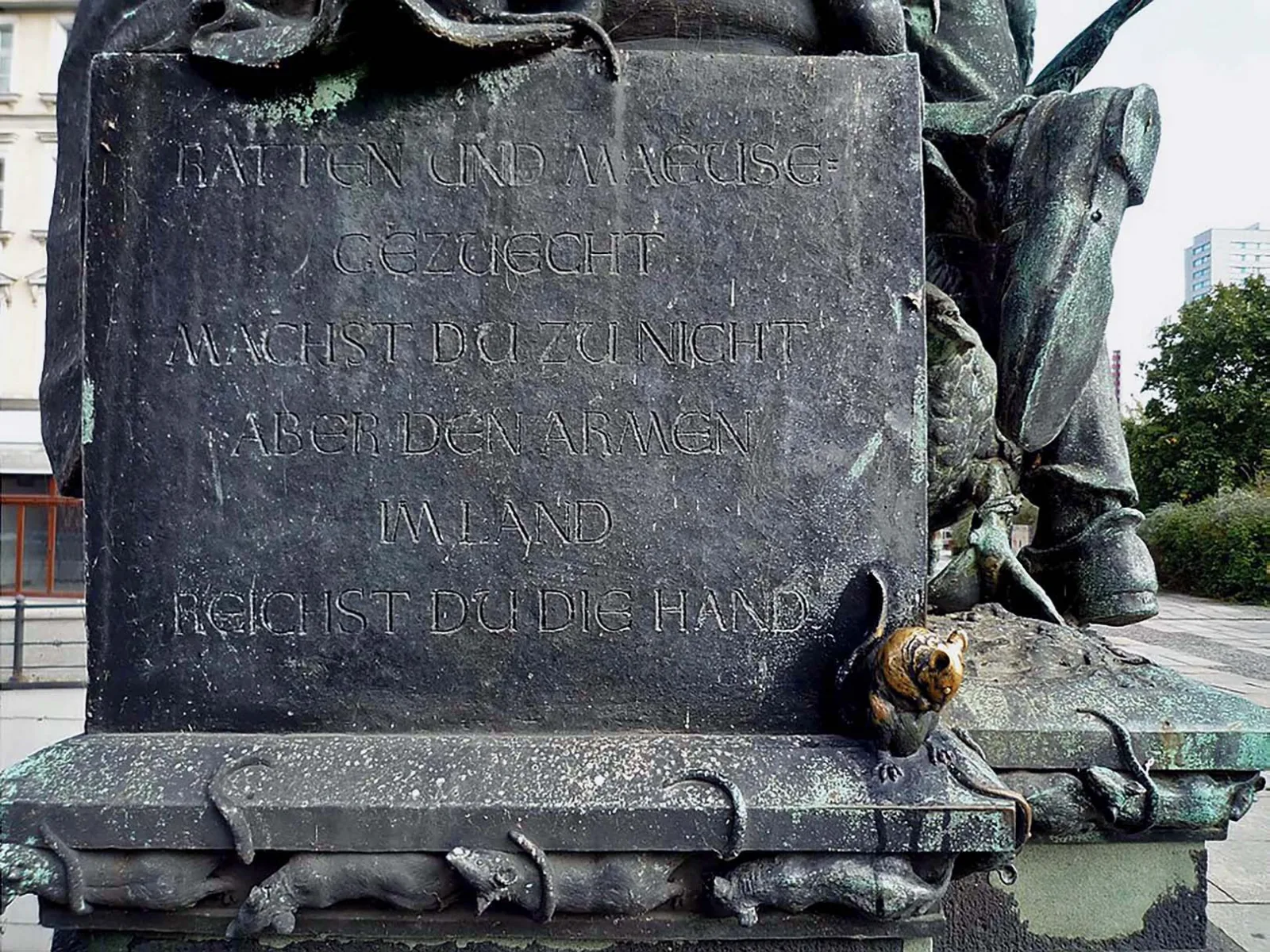
The cup in her hand is intended for a thirsty traveller to quench his thirst, or for enemies as a sign of reconciliation. The mice surrounding the saint serve as a reminder that prayer to her protects fields and barns from rodents.
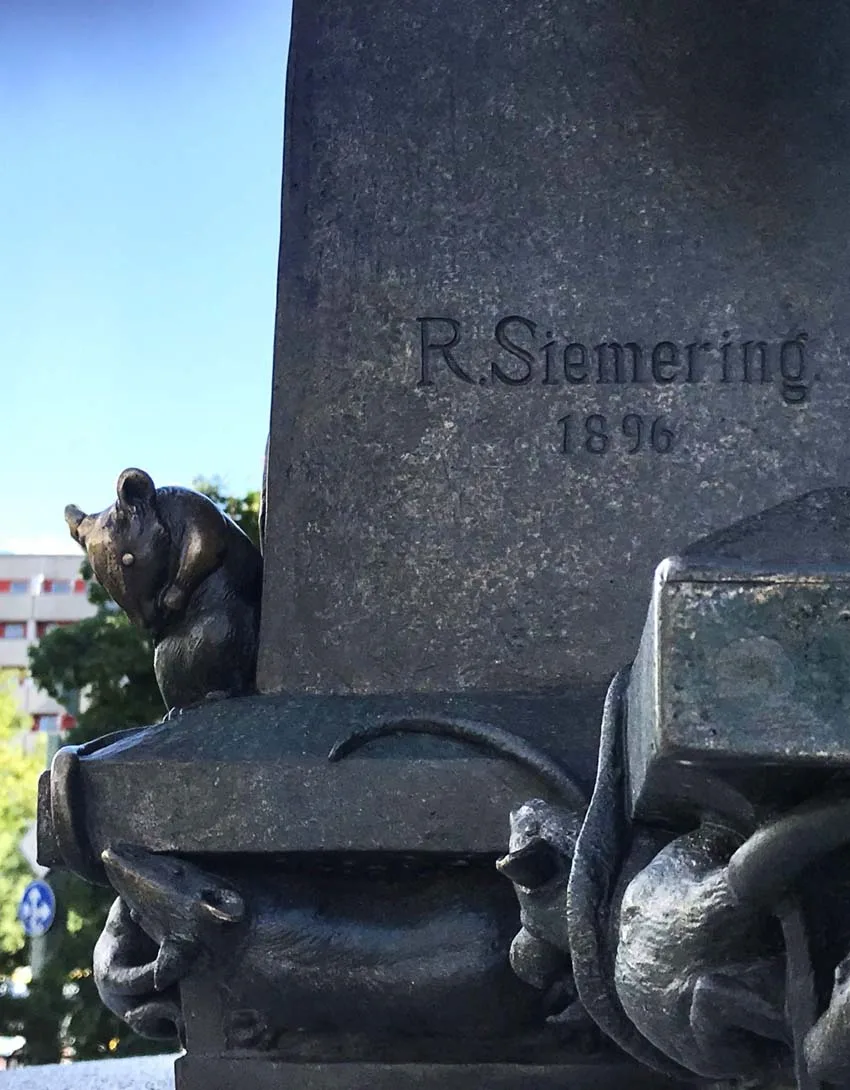
Siemering uses motifs from old legends about the saint, but brings the interpretation closer to his own time. Gertrude appears not in the guise of a nun but as a townswoman standing on the steps of the house from which she has just come out, still holding the spindle as a symbol of housekeeping. In the guise of a worthy matron and caring housewife with a bunch of keys, she greets the thirsty traveller. Paying no attention to whether this man deserves it, from whom a stolen goose is trying to run away, she looks down at him with a benevolent smile while he greedily drains the cup offered to him. The mice "carrying" the pedestal bring a smile: a superstition widespread in our day promises that whoever strokes them will see the amount of money in his purse grow.
In this composition symbolic motifs are combined with charming, kindly humour, and, despite the genre approach, the seriousness and grandeur of the historical figure are fully felt when looking at the sculpture.
Saint Gertrude with the journeyman. 1896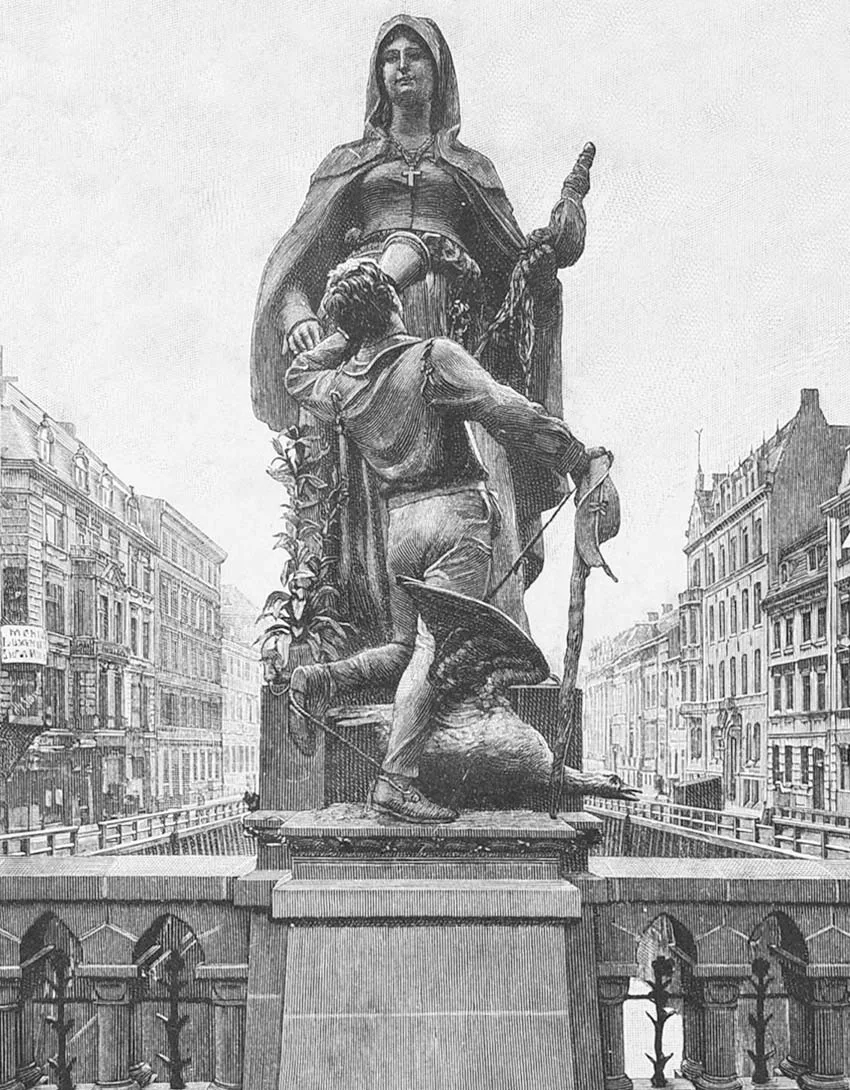
Another prestigious commission came from the Emperor, who ordered a statue of King Frederick William I for the Avenue of Fame in Berlin's Tiergarten. It was unveiled in 1902.
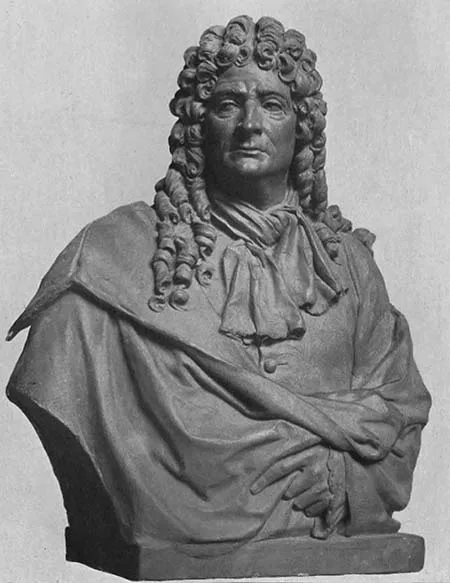
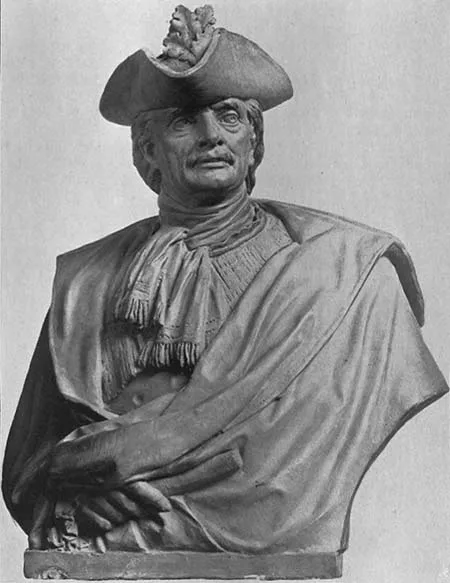
Two busts, of the minister Heinrich Rüdiger von Ilgen and of the field commander Leopold of Dessau, placed on either side of the main figure, were likewise marked by liveliness and realism.
In 1947 the Avenue of Fame was dismantled. But several figures were installed in those places in Berlin with which their subjects had a significant connection. Thus the bust of von Ilgen was installed in the park near the terrace of the manor house where he lived; since 1924 this landscape park has belonged to the city.
In the immediate vicinity of the group of animals and the monument to Frederick William, the Monument to the Great Composers was unveiled in the night of 1 to 2 July 1904. The author of the idea of erecting in Berlin a monument to Haydn, Mozart and Beethoven was Martin Blumner, director of the Singakademie (Singakademie). In 1895 the site was determined. Because of the marshy soil the monument has a complex architectural construction: its granite base rests on 8-metre reinforced-concrete columns. The monument has the form of a three-sided neo-Baroque "pavilion" with truncated corners. On three sides, half-figures of the composers look out as if from theatre boxes.
The domed vault of the roof narrows toward the centre, and its ridges end in gilded corner volutes; the roof is crowned by three gilded putto figures bearing a laurel wreath. The intended reflection of the monument in the water of the pond with goldfish was part of the design.
A monument in which sculpture and architecture merge into a single whole required complete mutual understanding between sculptor and architect. Help came from his son, Wolfgang Siemering, who had just graduated from the architecture faculty. This collaboration continued in subsequent projects. First of all, these were the Bismarck monuments, whose realization became desirable for two cities.
The committee in Bielefeld decided that the Bismarck monument should be made by Siemering. Given the limited resources, all decorative excess had to be abandoned, and the figure of the Chancellor appeared beside the new town hall on a cube of modest size made of black basalt lava.
The second project was "Bismarck Putting Germany in the Saddle" for Frankfurt am Main. The Iron Chancellor holds by the bridle a horse trampling a dragon. In the saddle sits solemnly an allegory of Germany, holding a banner.
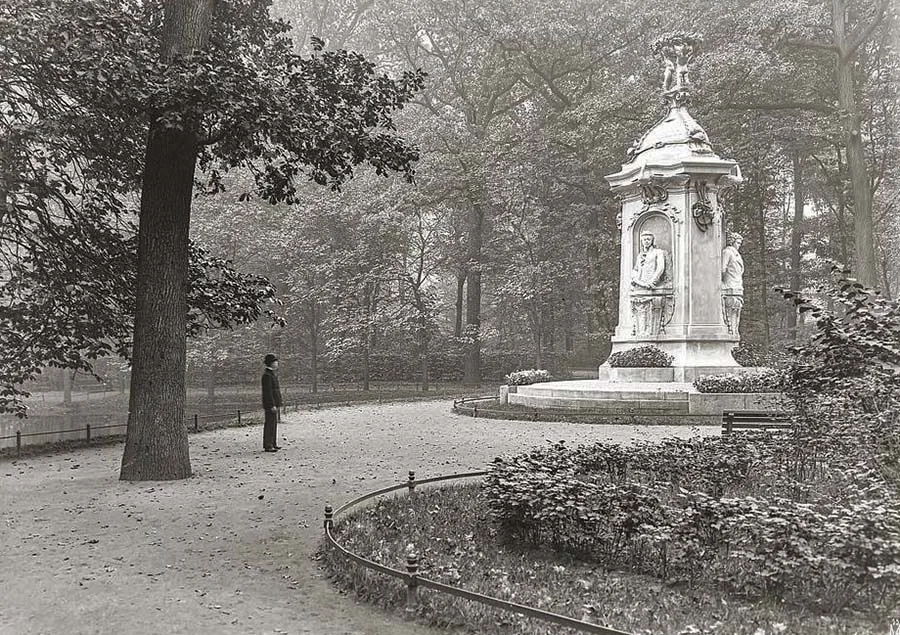
Beethoven-Haydn-Mozart-Denkmal in Berlin. 1904
The inscription on the pedestal reproduces Bismarck's words:
"Let us put Germany, so to speak, in the saddle! She will surely know how to ride."
(„Setzen wir Deutschland, sozusagen, in den Sattel! Reiten wird es schon können.“)
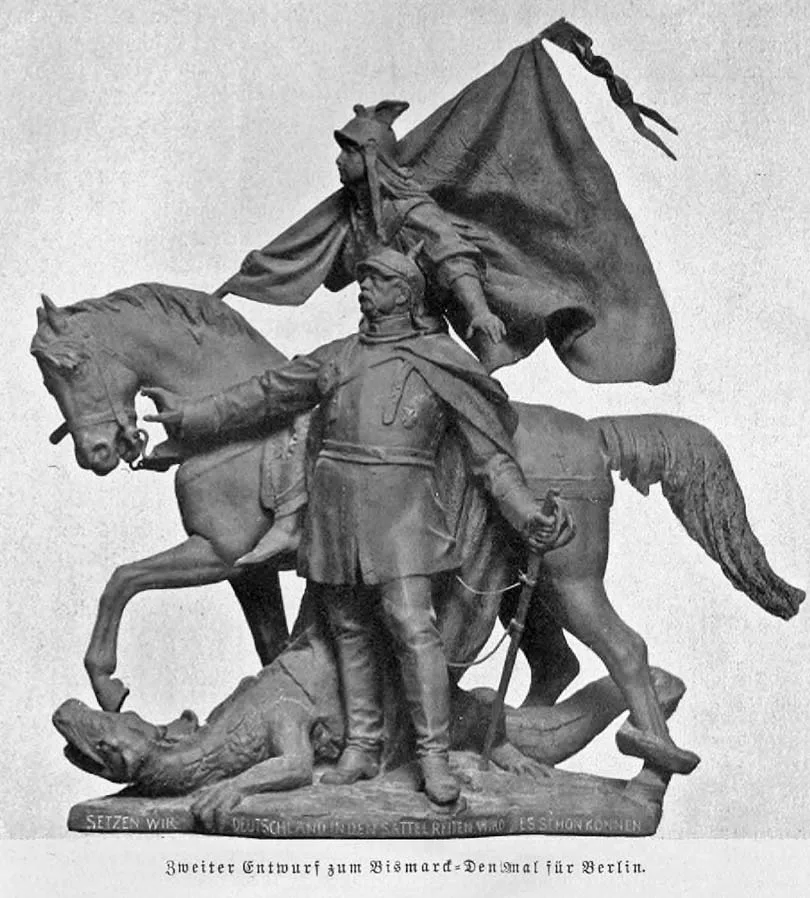
Model of the monument Bismarck putting Germany in the saddle. 1908
Königsberg's great son Rudolf Siemering died on 23 January 1905 in Berlin, when the large preliminary model was at an early stage, and his son completed the work. The monument was unveiled on 11 May 1908.
Besides his monumental works, Siemering often portrayed well-known and influential contemporaries: there are many busts created by him in different periods. His early works include a portrait of the politician Jacoby; his later ones include busts of Professor Wagner (Königsberg), Friedrich Kapp (Berlin) and President Eduard von Simson, portraits of his friend the architect Martin Gropius, of the surgeons Bardeleben, Wilms and Langenbeck, and many others.
Rudolf Siemering was one of the most sought-after monumentalists of the 19th century; his works still adorn many cities from Malbork to Philadelphia.
He owed his success to strength of character and incredible industry. It is a paradox, but the monuments that made him famous as a great sculptor stand far from Berlin, often in small towns, and his grandest creation, the monument to Washington, is overseas.
The frieze of 1871 alone brought him the title of professor; later he became a member of the senate of the Academy of Arts and an honorary doctor of the University of Leipzig; he was awarded the Great Gold Medal in the field of art and decorated with the Order of the Red Eagle, second class, with oak leaves and crown.
In Königsberg, during the sculptor's lifetime, a street was named in his honour, now Polyusnaya Street. It is a small street connecting Sportivnaya Street (formerly Lovis-Corinth-Strasse) and Chkalov Street (formerly Zeppelin Street).
Illustrations:
Wikipedia;
Website Sculpture in Berlin;
Berthold Daun’s book “Siemering” (Bielefeld; Leipzig: Velhagen & Klasing, 1906).